Section 202 and other HUD housing for older renters
Last updated
What the Section 202 program is, how it differs from a 55+ community, and how to read the HUD property layer on this site.
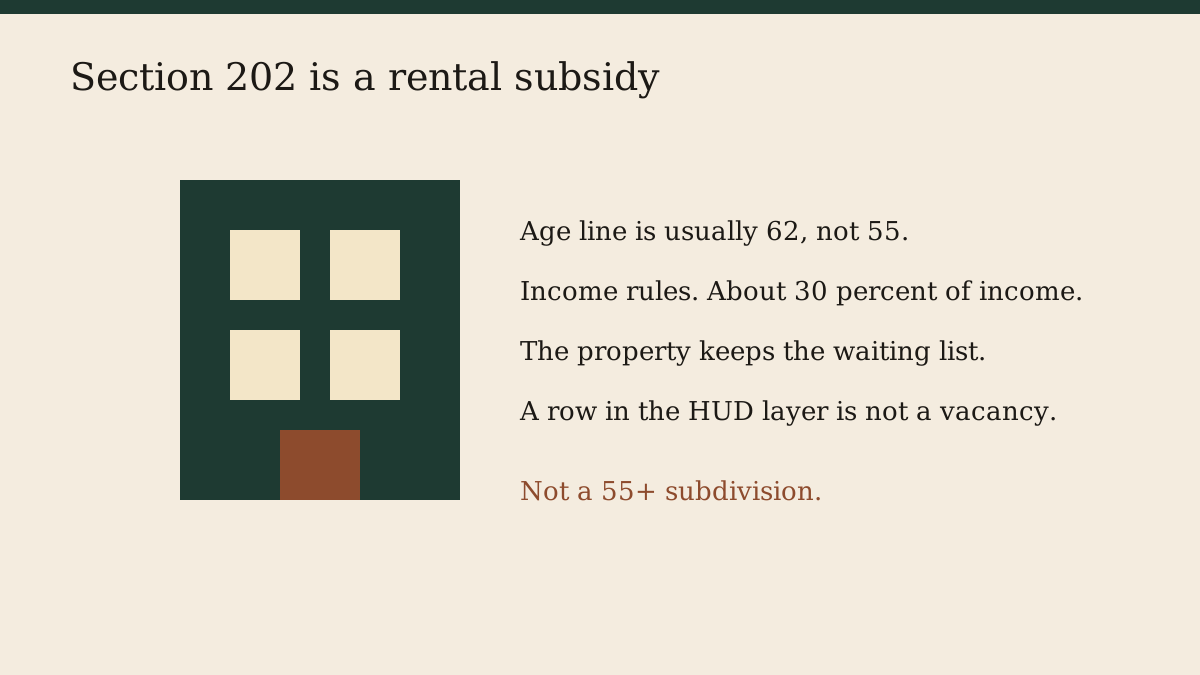
Section 202 is a HUD program that helps nonprofits build and run housing for older people with low incomes. It is not a 55+ subdivision, it is not assisted living, and a row in a dataset is not a vacant apartment. Families lose months confusing those three. This guide separates them, then explains the property list on our state pages so you can use it without thinking we are the waiting list.
What the program is
HUD’s own program page describes Section 202 as housing for the elderly: supportive housing for very low-income people who are at least 62. The help is rental assistance, so the tenant pays about 30 percent of income, and a subsidy covers the rest of an approved rent. Newer properties often have a Project Rental Assistance Contract, a PRAC. Older ones may have a Project Assistance Contract, a PAC, or a Section 8 contract tied to a 202 property. Some have a service coordinator, a person whose job is to connect residents with help in the community, not to provide medical care.
The age line is 62 for the program as HUD describes it. That is not the Fair Housing Act’s 55+ exemption. A 55+ community can be market-rate houses with a clubhouse. A 202 property is subsidized rental housing with income rules. You can be 70 and far too high-income for 202. You can be 58 and qualify for a 55+ condo you can afford to buy, and be too young for 202. Write the two ages down if you keep mixing them up. We did, for years, whenever a brochure said “senior housing” and meant whichever one it was selling.
Care is limited. A service coordinator is not a nurse on the night shift. Many residents hire their own help or use Medicaid home care or Older Americans Act services and live independently in the apartment. If you need assisted living, you are shopping for a state license, not for a 202 waiting list. Some properties have a relationship with a care provider. Ask. Do not assume.
What our table is
The properties on a state housing page come from HUD’s Section 202 feature layer, the one cataloged on data.gov. HUD’s description of that layer says it maps multifamily properties that primarily serve older residents and that have at least one of a set of active contracts or grants: a service coordinator, certain Section 8 contracts, a 202 PAC, a 202 PRAC, and related assistance. The catalog record dates the coverage to June 2026. We downloaded the layer on November 20, 2026. The latest update time we saw inside the layer was October 6, 2026. Addresses that HUD could not geocode may be missing from a map layer. HUD says that plainly. So a missing building is not proof it does not exist, and a listed building is not proof it has an opening.
We kept the property name, address, city, county, the on-site phone HUD published, the assisted-unit count, the client group, and a few yes/no flags: 202 PRAC, 202 PAC, Section 8/202, a 202 direct loan, a 202 capital advance, and the combined 202/811 flag. If none of those six flags was yes, the table says “Listed in the HUD layer” instead of inventing a contract type. The client group is whatever text HUD stored. We title-cased all-caps names so they are readable. We did not call the property to confirm the phone. Phones in a federal extract go stale. Call, and if it is dead, use the HUD Resource Locator rather than a random website that scraped the same file and added a lead form.
We did not publish manager email addresses. Those are often a named person. The on-site property phone is the number HUD put on the property. That is the one in the table.
How to actually get on a list
The waiting list is kept by the property or its management agent, not by HUD as a single national queue, and not by us. Call the property and ask whether the list is open. Ask what “open” means. Some lists open for a week every two years. Some are closed and the voicemail does not say so. Ask about income limits for the household size you actually have, not for a generic senior. Ask about accessibility if you need a wheelchair unit. Ask what fees are not rent. Ask whether a criminal-record or credit screen is used, and get that policy in writing before you pay any screening fee.
Then check the HUD Resource Locator at resources.hud.gov. It is HUD’s own search for rental help, counseling, and other local HUD contacts. It will not always show the same set of pins as the Section 202 layer, because it is a broader tool. Use both. HUD User also publishes assisted-housing datasets if you want the statistical side, including picture-of-subsidized-households style files. Those are research files. They are not an application.
The Area Agency on Aging, through the Eldercare Locator, sometimes knows which local lists are open because caseworkers place people for a living. They are a better second call than a national referral advertisement. They still cannot put you at the top of a closed list.
What this housing is not
It is not public housing, though a public housing authority may own other buildings for older people under a different program. It is not the Low-Income Housing Tax Credit by itself, though some properties have tax credits layered on a HUD contract. Our flag list does not try to describe every financing stack. If you need the capital stack, you need the property’s own documents, not a map layer.
It is not a nursing home. A nursing home is in the CMS file and has a certification number. If a 202 property and a nursing home share a name, they are still two licenses. Look up both.
It is not a guarantee of a service coordinator forever. Grants end. The layer is a snapshot of contracts HUD considered active for the map. A coordinator on a 2024 brochure may be gone. Ask who is in the office this month.
It is not free. Thirty percent of income can still be a hard number if income is a small Social Security check and medical costs are high. Ask about utility allowances. Ask what happens if you go to the hospital for a long stretch. Occupancy rules during a hospital stay are a common way people lose an apartment they waited years to get. Get the rule before you need it.
A sane order of calls
One: decide whether you need a subsidized apartment or a care license. If it is care, stop and read the assisted-living guide. Section 202 will not become a nursing home because you waited.
Two: open our state housing table and write down two or three properties near the right town, with the phones from the HUD file.
Three: call and ask if the list is open. Write down the person’s name and the date.
Four: if every list is closed, call the Area Agency on Aging and ask what else exists in the county: public housing, tax-credit buildings, or state vouchers. Those will not be complete in our 202 table. We would rather send you to the locator than pretend the layer is the whole market.
Five: ignore any site that says it can “get you a senior apartment” if you enter a phone number first. The list is kept at the property. The public data is already on HUD’s site and, for this layer, on ours with the date we checked it. Nobody honest needs your Medicare number to show it to you.
What to have in your hand when you call
Have the household’s monthly income written down, before deductions you hope will count and after the ones you know will not. Social Security, a pension, and wages are the usual pieces. Have the number of people who would actually live there. Income limits are set by household size and by county, and the property applies HUD’s numbers. Do not ask us to print this year’s limit. It changes, and the property is the one that will say yes or no.
Ask whether they need a birth date, a Social Security number, and a bank statement to put you on the list, or only to take you off it later. A list that demands a pile of documents while it is closed is a reason to ask what “closed” means. Some properties take a preliminary form and call you when the list opens. Some will not take your name at all. Write down which one you reached, the date, and the person’s name.
If you have a disability and need a specific kind of unit, say so at the start. Accessible units are scarce inside an already scarce program. Asking later, after you have waited two years for a walk-up, is how people lose the wait.
When every list is closed
That is normal in a lot of counties. It is not a sign you did the search wrong. Call the Area Agency on Aging and ask what else older renters use: public housing for the elderly, housing choice vouchers if the waiting list is open, and tax-credit buildings that are not in the Section 202 layer. HUD’s resource locator is the other public search. A closed 202 list does not mean those are closed.
Be careful with anyone who says they can place you for a fee. The property keeps the list. A fee does not move you up a HUD waiting list. If someone asks for your Medicare number in order to “match” you with senior housing, they are not HUD. Hang up. The data is already public. The wait is real. Paying a stranger does not shorten it.
If you are 55 and the building is 62-and-over, no amount of persistence changes the program rule HUD publishes. Look at ordinary housing and at the fair-housing exemption for 55+ communities, which is a different law and usually a different price. Mixing the two is how people spend a year on the wrong list.