How to verify that a community is really 55+
Last updated
The Housing for Older Persons rules, the 80 percent test, and the papers to ask for before you believe a sign at the gate.
A sign that says “55+” is a claim about the Fair Housing Act, not a review from a government housing inspector. The Act generally forbids housing discrimination based on familial status, which is the legal term that protects families with children. Congress carved out an exemption so some communities can operate as housing for older people. The exemption is narrow, and a community that wants it has to keep proving it. A brochure is not the proof.
We do not publish a directory of 55+ communities. There is no federal registry that is both complete and public in a form we can cite, and the commercial directories are sales tools. What we can do is show you the rule and the papers worth asking for. The rule is in 24 CFR part 100, subpart E. HUD’s fair housing office is the federal home of that rule. States and cities often have their own fair-housing agencies that take complaints. If a community is faking the exemption, those are the offices that care.
Two different age exemptions
Read this slowly, because sales offices blur it.
Housing for persons 62 and older is the stricter idea. It is housing intended for, and occupied solely by, people 62 or older. “Solely” is the word. A community that lets in 55-year-olds is not using this exemption.
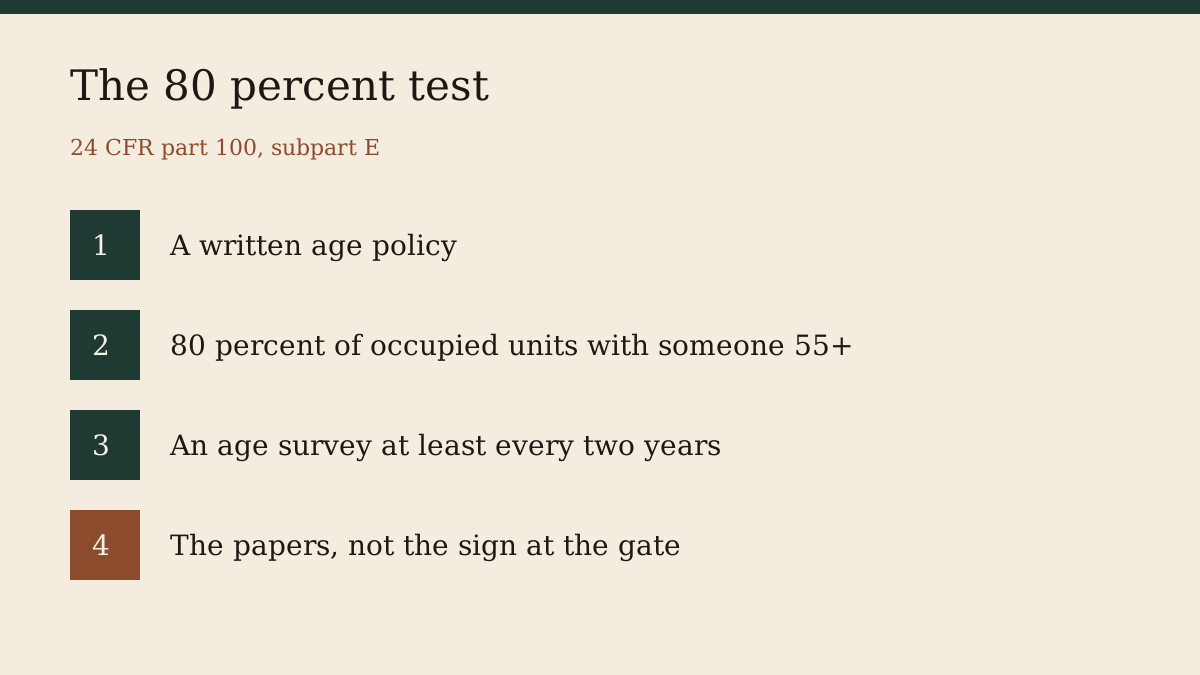
Housing for persons 55 and older is the one you see on gates. The community must intend to be housing for people 55 and older. At least 80 percent of the occupied units must be occupied by at least one person who is 55 or older. The community must publish and follow policies that show the intent, including a way of checking ages, and it must check ages at least once every two years. The other 20 percent is not a promise that you can move in at 40. The community can still set its own rules, as long as those rules are not a cover for some other kind of illegal discrimination. The 20 percent is slack in the federal test, not an invitation.
Employees who live on site, and some units occupied under specific exceptions the rule describes, are handled separately. Do not try to run the percentage from a driveway count of children. Ask for the community’s own survey.
HUD’s rule also says the exemption is lost if the community does not actually do these things, no matter what the sign says. Intent shows up in the advertising, the leases, the rules, and the age checks. A community that advertises “perfect for families” on one flyer and “55+” on another has a problem it should be able to explain.
The papers to ask for before you put down a deposit
Ask for the age-verification policy in writing. It should say how the community confirms that someone is 55 or older. Driver’s licenses, passports, and immigration documents are the usual reliable evidence the rule talks about. A community that says “we can tell by looking” does not have a policy.
Ask for the latest occupancy summary: how many units are occupied, and how many of those have at least one resident who is 55 or older. You want the date of the survey. A summary from 2019 is not a survey. The rule expects a check at least every two years. If they will not show you a summary, you are being asked to trust a sign.
Ask for the recorded covenant or the lease clause that states the age rule, and ask what the association can do if a unit stops qualifying. Enforcement against an owner is a private legal process. You want to know, before you buy, whether a death or a younger heir can blow up the exemption for the street, and what the board actually does when that happens. Some communities handle it carefully. Some ignore it until a fair-housing complaint arrives.
Ask who is allowed to live with the 55-year-old. A spouse under 55 is a common and usually intended case. A grandchild for the summer may be allowed as a visitor and forbidden as a resident. The difference matters if you are the childcare plan for your daughter. Get the visitor rule and the occupancy rule as two separate pieces of paper.
Ask about the amenities the marketing calls “senior services.” A clubhouse and a lawn crew are not care. If the packet mentions aides, medication, or a nurse, ask which licensed entity employs them. A 55+ community can share a road with an assisted-living building. They are not the same door. Our guide on independent living, assisted living, and nursing homes is the map for that mix-up.
What the exemption does not do
It does not cap the price. It does not make the community eligible for Medicare. It does not promise a bus to the doctor. It does not mean HUD inspected the roofs. It does not mean the homeowners association is well run. Those are ordinary real-estate questions: reserves, insurance, special assessments, rental caps, and whether you can get a mortgage. A lender may treat an age-restricted project differently. Ask the lender early, not the day before closing.
It also does not let the community discriminate on race, color, religion, sex, disability, or national origin. The older-persons exemption is about familial status. A community that uses “55+” as a polite way to keep out some other group of people is not protected by the exemption. HUD’s fair housing office takes those complaints. So do state fair-housing agencies. You do not need us as a middleman, and you should not send the complaint only to the board that is the problem.
If you need subsidized rent rather than an age-restricted house you will buy, you are in a different program. Section 202 and other HUD assistance for older renters are income-tested and usually tied to age 62. Those properties are in a HUD dataset. We publish the Section 202 layer by state and explain it separately. A 55+ subdivision with a golf course is not that dataset.
How to smell a fake without becoming a lawyer
You are not trying to win a fair-housing case on a Saturday. You are trying not to buy the wrong house. These are the answers that should make you pause.
“We’re 55+ because the developer said so in 1998.” Age restrictions have to be lived, not just printed once. Ask for the current survey.
“About 80 percent, I think.” The test is a count of occupied units, not a vibe. Ask for the count.
“We don’t put that in writing.” Then you don’t have a policy you can rely on, and the federal rule expects one.
“Kids are fine, we just say 55+ for the ads.” That community may not have the exemption at all. Families with children who are turned away later will have a complaint, and you may have bought into a fight.
“The nursing home on the hill is part of the package.” Only if a contract says so. A view of a nursing home is not a contract. The CMS file can tell you whether the nursing home itself reports that it is part of a continuing-care campus. It cannot tell you that your cottage is tied to a bed.
Where public offices fit
The Eldercare Locator, eldercare.acl.gov, will connect you to the Area Agency on Aging for a given address. That agency is not the 55+ police. It is the office that knows about meals, rides, and caregiver support if you move there and later need them. It is worth calling before you move, so you know the real local help and not the brochure’s version.
Your state attorney general or the state real-estate commission may care about a sales claim that is simply false, which is a different problem from a fair-housing problem. A false “we are 55+” in an ad can be both. Keep the ad.
HUD’s fair housing materials are the federal explanation. They are written for the public and for people who file complaints. Read subpart E if you want the actual test. It is not long, and it is clearer than a sales sheet.
We will not build a map of communities that “passed.” Passing is not a status we can download. It is a practice a community either keeps up or doesn’t. The papers above are the check. If a seller will not show them, you already have your answer, and it does not require a directory.
Buying the house is a separate problem from the age rule
The exemption tells you who may live there. It says nothing about whether the association has the money to replace the roofs. Ask for the current budget, the reserve study if the state requires one, and the special assessments from the last five years. An age-restricted street with an empty reserve is an ordinary expensive house with a rule about grandchildren. Get the resale certificate or the estoppel the state uses, and read the delinquency rate. A community that is busy enforcing age rules and behind on collecting dues is telling you about its priorities.
Ask the lender, early, whether the project is eligible for the loan you want. Some age-restricted projects fail condo questionnaires because too many units are rentals or because reserves are thin. You do not want to learn that after the inspection.
If you are renting rather than buying, the lease should state the age rule and the visitor rule. A landlord who says the rule is “just for owners” may not have the exemption in the first place. Ask to see the policy that applies to tenants. Keep a copy. If you are later accused of violating a rule nobody gave you, the missing paper is the argument.
Fair housing complaints still go to HUD’s fair housing office or the state agency, not to a directory. We will not mediate them. We also will not list communities that “passed,” because passing is a practice, measured by an occupancy survey at least every two years, not a badge we can download. Ask for the survey. If they will not show it, do not pay the deposit while you think about it.