Independent living, assisted living, and nursing homes are not the same license
Last updated
How the four settings people lump together are actually regulated, who pays, and which of them show up in a CMS file.
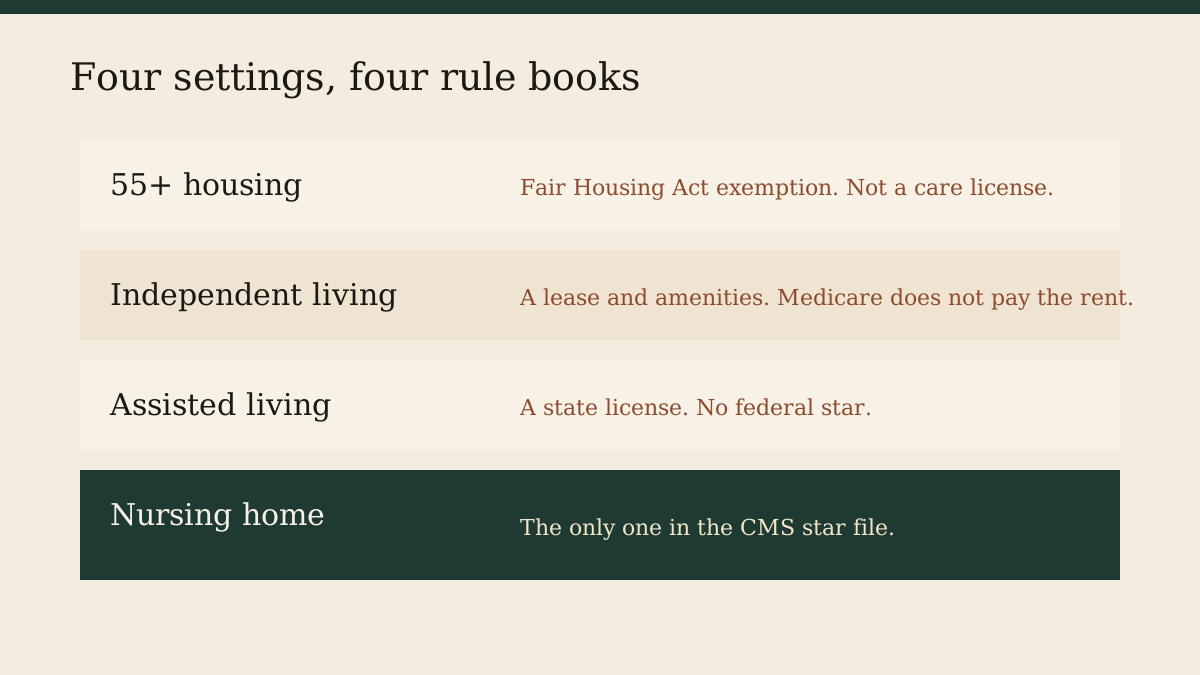
People shop for “a place for Mom” as if it were one product with four price tags. It isn’t. A 55+ apartment, an independent-living building, an assisted-living license, and a Medicare nursing home are regulated by different offices, paid for in different ways, and listed in different databases. Mixing the names up is how families end up touring a building that cannot legally provide the care they need, or ruling out a nursing home because they think the star system covers the assisted-living place down the street. It doesn’t.
This is a map of the names. It is not a recommendation of a building.
A 55+ community is a housing rule, not a care license
A 55+ community is usually ordinary housing that is allowed to prefer older residents under the Housing for Older Persons exemption in the Fair Housing Act. The rule lives in 24 CFR part 100, subpart E. The short version is that the community has to intend to operate as housing for people 55 and older, has to have at least 80 percent of occupied units with a person 55 or older, and has to check ages on a regular basis. There is a separate, stricter exemption for housing meant only for people 62 and older.
None of that is a license to give baths, manage medications, or supervise someone with dementia. The community can be a subdivision of houses, a condo, or an apartment building. The association or the landlord enforces the age rule. The state health department usually has nothing to do with it unless the same campus also holds a care license. A sales packet that says “carefree living” has not created a care license. If you need someone on staff at 2 a.m., ask who employs that person and which state license covers them. If the answer is “nobody, this is independent,” believe it.
There is no federal list of these communities that we are willing to republish. Sales sites have lists. Those lists are advertisements. Our guide on verifying a 55+ claim walks through the questions that matter more than a directory.
Independent living is a lease, plus whatever amenities the lease names
Independent living, in the way marketers use it, means an apartment or cottage where the rent may include meals, housekeeping, or a shuttle, and where you are expected to handle your own care. It can sit inside a 55+ community or on a campus that also has assisted living. The lease is the document. Read what happens if you start to need help. Some buildings will let you hire your own aides. Some will tell you that you have to move to another part of the campus. Some will say you have to leave.
Medicare does not pay the rent. A long-term care insurance policy might pay for care you receive in the apartment, under the policy’s own definitions, which you have to read. The building’s monthly fee is a private contract. HUD subsidized apartments for older people are a different product again: the Section 202 program is rental assistance tied to income and, usually, age 62, not a 55+ hobby community. We list properties from HUD’s Section 202 map layer on the state pages and explain that layer in its own guide. Do not treat those rows as independent-living “communities” in the brochure sense.
Assisted living is a state license, and the name changes
Assisted living is where the vocabulary falls apart. One state says assisted living. Another says residential care facility. Another says personal care home. The license covers a package of help with daily life, things like bathing, dressing, and reminders about medication, and sometimes a limited amount of nursing. It is not a federal Medicare benefit, and CMS does not give these buildings a five-star rating.
That is why this site does not have a national assisted-living table. Copying one from a referral company would just repeat their phone book, and inventing one would mean inventing phone numbers. The state that issued the license is the place that can tell you whether a building is allowed to operate, whether it is allowed to call a unit “memory care,” and what the last inspection found. The state unit on aging, which you can reach through the Eldercare Locator, can point you at the licensing lookup. Our state pages link the state unit’s own website when that website answered on the day we checked. When it did not, we say so.
Ask the building for the license number and look it up yourself. Ask what the license does not allow. A common painful surprise is a building that can house someone with mild memory loss and cannot house someone who wanders or who needs a mechanical lift. The brochure’s phrase “we do memory care” is not the license. The license is.
Payment is mostly private. Medicaid in some states will pay for assisted living through a waiver, for people who qualify financially and functionally. The waiver is not automatic, the building has to participate, and the rules are the state’s. Medicare, the health insurance, does not pay the assisted-living rent. People mix those two programs up every week. Medicare may still pay for a doctor, for hospital care, or for a home health episode if you qualify for home health while you live in the building. The room and the aide are a different bill.
A nursing home is the one in the CMS star file
A nursing home in the CMS file is a facility certified to provide nursing care under Medicare, Medicaid, or both. Certification is federal, surveys are done by the state under contract with CMS, and the star rating is the CMS summary described in the Five-Star users’ guide. Our state tables are that file. If a building is not in the table, it is not a certified nursing home in the file we downloaded. It might still be a licensed assisted-living building. It might be a hospital swing bed. It might have closed. Care Compare is the live check.
Medicare pays for a limited skilled-nursing stay under the rules on its nursing-home coverage page, often after a qualifying hospital stay. That is not the same as paying for someone to live in a nursing home for years. Long stays are private pay or Medicaid. The star does not tell you which bed is open or which payer the home will take.
Some nursing homes sit on a campus that also has independent apartments and an assisted-living license. The CMS field “continuing care retirement community” is the nursing home saying it is part of that kind of campus. In the October 2026 file, 1,548 homes said yes. The apartments upstairs are not rows in the nursing-home table. The contract that ties the apartment to future care is a state matter, sometimes watched by the insurance department because an entrance fee can be an insurance-like promise. Read that contract, or pay a lawyer who reads them, before you treat the campus as one product. Our guide on continuing-care questions is the list we would want in front of us. It is not a review of any campus.
A practical way to sort a brochure
Take the brochure and write four questions in the margin.
Who holds a license, and from which office? If the answer is only a business registration, you are looking at housing. If the answer is a state assisted-living license, ask for the number and the latest inspection. If the answer is a CMS certification number, the home should be on Care Compare and in our table.
What help is included in the monthly fee, and what is extra? “Care” as a word is not a schedule. Ask who helps with a shower, on which days, and what happens on the day you need two people to transfer.
What happens when needs change? Get the answer in the lease or the contract, not from the tour guide’s memory. The painful version of this conversation happens after a fall, when someone is in the hospital and the building says the person cannot come back.
Who pays? Circle rent, circle care, circle Medicare, circle Medicaid. If the salesperson slides from one to another without a breath, stop and separate them on paper.
Then use the Eldercare Locator, at eldercare.acl.gov, to find the Area Agency on Aging for the address. That office will not be the salesperson. It is the public front door for meals, rides, caregiver support, and a straight description of what the state calls assisted living. SHIP, the State Health Insurance Assistance Program, is the separate free desk for Medicare questions. Do not ask the building’s marketing office to explain Medicare. They are not paid to be neutral about it.
What this site will show you, and what it will not
On a state page you can see every certified nursing home in the CMS file, the home health agencies, the hospices, and the HUD Section 202-layer properties. You can see whether CMS marked a nursing home as part of a continuing-care campus. You cannot see a ranked list of assisted-living buildings, because we do not have a federal file that would make that list honest. You cannot see every 55+ subdivision. If a page on the internet offers you all of those with star ratings attached, ask which government file the stars came from. If they cannot name one, the stars are a product.
The names are the whole problem. Once you know which license you are actually shopping for, the public record is easier to find, and the brochure is easier to put down.