How assisted living licensing works, and why there is no federal star
Last updated
Assisted living is a state license with a different name in every state. How to find the lookup, and what a license does not promise.
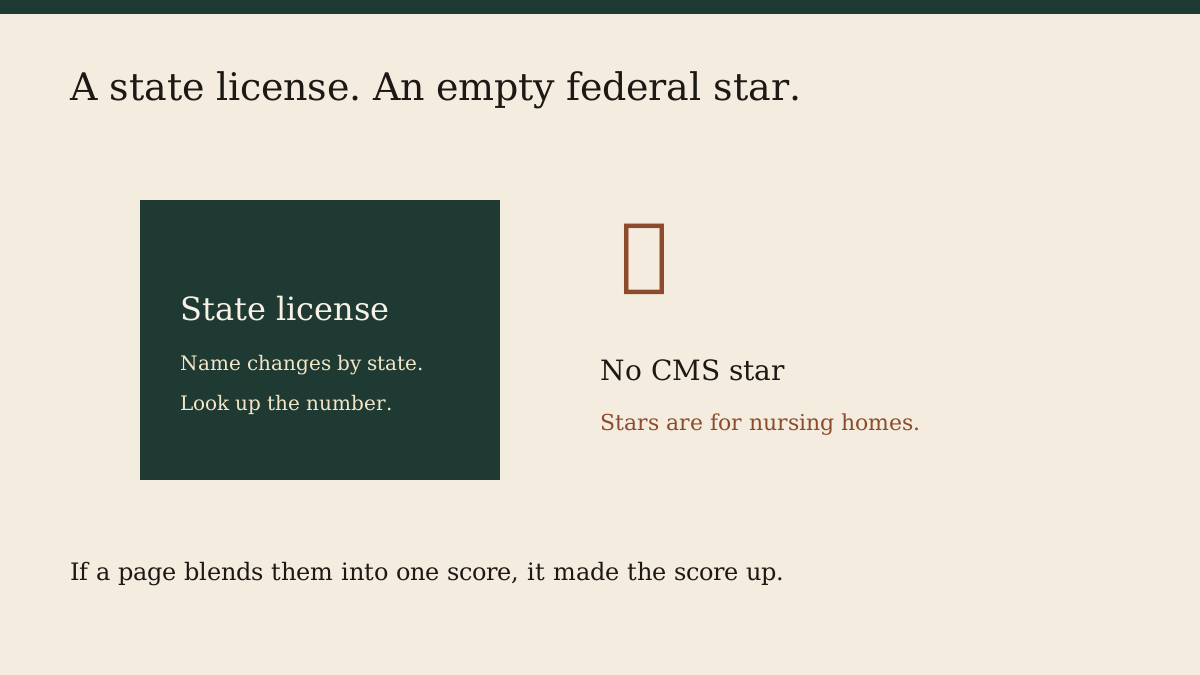
If you are looking for a five-star assisted living building, you are looking for a thing CMS does not publish. The Five-Star system is for Medicare-certified nursing homes. Assisted living is licensed by the state, under a name the state chose, with an inspection file the state keeps. A website that slaps stars on assisted living has made those stars up, or it has borrowed a private company’s scoring and called it official. This site will not do that. Here is how the real license works, and how to find it.
What the license is
A state decides that a building which houses people and helps them with daily life needs a permission slip. The help is bathing, dressing, meals, supervision, medication reminders or administration, and sometimes a limited nursing service. The state writes rules about staffing, training, the size of rooms, fire safety, and what happens when a resident gets sicker than the license allows. Then it surveys the building, writes deficiencies, and can fine or close it.
The name of the license is the trap. California talks about residential care facilities for the elderly. Another state says assisted living facility. Another says personal care home or adult foster care. The care inside can be similar. The rule book is not. You cannot take a checklist from your old state and assume the new state used the same words. Our moving guide is about that kind of assumption. This one is about finding the rule book you actually live under.
The state unit on aging is not always the licensing agency. Sometimes licensing sits in the health department. Sometimes it sits in a human-services department. ACL’s description of state units on aging is the federal map of the aging agencies. The state unit, or the Area Agency on Aging you reach through the Eldercare Locator, can tell you which office holds the license lookup. We link a state unit’s website on our state page only when that site answered on the day we checked. California’s Department of Aging, aging.ca.gov, is an example of a state unit site that did. Your state may use a different address. Use the locator if our page does not show one. Do not trust a commercial “license search” that asks for your phone number before it shows you the public record.
What to look up, and what to ask the building
Get the exact legal name and the license number from the building, then search the state site yourself. Names on signs are marketing. The license is issued to a legal entity. If you cannot find the entity, ask why. A building “in the process of licensing” is not a licensed building.
Read the last inspection. States vary in how much they post. Some post the full survey. Some post a summary. Some make you request it. A refusal to tell you how to see the latest survey is a reason to keep looking. Deficiencies are normal. A pattern of the same deficiency is the thing you are reading for. Staffing, medication, and elopement show up because those are the ways people get hurt.
Ask what the license prohibits. This is more useful than what it allows. Many licenses cannot take someone who needs a two-person transfer, or who has a feeding tube, or who wanders, or whose dementia includes aggression. The building may still say yes on the tour and then send the person to the hospital after move-in and refuse the return. Get the admission and discharge criteria in the contract. Compare them to the person’s actual needs, including the needs you are afraid to say out loud.
Ask who is in the building at 2 a.m. A license might require an awake staff person, or it might allow a sleeper. The difference is the difference between a responded fall and a morning discovery. Ask the ratio the license requires and the ratio they actually run. Those are two numbers.
Ask about medication. “Reminders” and “administration” are different acts, often different rules, and different levels of nurse. A building that administers medication has a heavier duty and a heavier failure mode. Ask how errors are reported.
Money, because the license will not pay the bill
Assisted living is mostly private pay. A monthly fee plus a level-of-care charge is the usual shape. The level can move up after you move in, and the contract lets it. Ask how levels are assessed and how much notice you get before the fee changes. Ask what is extra: incontinence supplies, escorts to meals, a second person for bathing.
Medicare does not pay the assisted-living fee. It may pay for a doctor, a hospital stay, or a qualifying home health episode while the person lives there. The rent and the aide are not that episode. Medicaid in some states pays for assisted living through a waiver for people who meet both the income test and the need-for-care test. The building has to participate. The waiver has a slot limit. The state unit or the Area Agency on Aging can tell you whether your state even has this, and what the program is called. We will not print a national “Medicaid pays for assisted living” line, because in some states it barely does.
Long-term care insurance may pay, if the policy’s trigger is met and the building is a kind of facility the policy names. The policy language controls. The marketing director’s “we take insurance” can mean they will help you file, not that the insurer will pay.
The ombudsman and the nursing-home confusion
Many states extend the long-term care ombudsman to assisted living, not only to nursing homes. The national resource center is ltcombudsman.org. Ask the local ombudsman whether assisted living is in their jurisdiction. If it is, they are the person residents can call. They are not the licensing inspector. They are an advocate. Use both.
If the person needs daily skilled nursing, a ventilator, or care that the assisted-living license forbids, you are in nursing-home territory. That is the CMS star system, Care Compare, and our state nursing-home table. A campus that offers both should be able to show you two different licenses and explain, in the contract, what it costs to move from one to the other. If they show you one shiny star and it belongs to the nursing home you are not moving into, they have not answered the question you asked.
We will keep saying this until it is boring. Boring is the point. The license is a state file. The star is a federal file for a different building. Any page that blends them into one score is selling you a shortcut. The lookup takes an afternoon. The wrong building takes a year.
How to read the inspection you finally find
State surveys are not written for families, but they are readable if you look for repeats. A single citation for a missing signature is not the same as three citations, over two years, for medications given to the wrong person. Write down the tag or the phrase the state uses, the date, and whether the state marked it corrected. Then ask the building what “corrected” looked like. A corrected medication error might mean they rewrote a policy. It might mean they changed who gives the pills at night. You want the second kind of answer, with a name and a shift.
Staffing citations deserve the same treatment. The rule might require one awake staff person for a certain number of residents. The survey might say they were short on three nights the inspector checked. Ask what the schedule is this month, not what the policy binder says. If they will not show you a schedule with names, you have learned something.
Elopement and wandering show up because memory care units fail in a specific way: a door that was supposed to latch did not, or a resident left and nobody noticed for an hour. If the building markets memory care, ask for every citation in the last two years that mentions a door, a missing resident, or an alarm. A clean answer is a short list and a description of the fix. A defensive answer is a speech about how much they care.
Money questions to ask before the assessment fee
Many buildings charge an assessment fee or a community fee before you have a contract. Ask whether it is refundable if they later say they cannot take the person. Ask what the fee buys: a nurse’s visit, or a sales appointment with a clipboard.
Then ask for the rate sheet with levels. A base rate that looks affordable and a level-three rate that is double is a common structure. Ask who decides the level after move-in, how often they reassess, and how many days’ notice you get. Ask what happens if you disagree. Get the notice period in the contract, not in an email from the marketing director who may not work there in March.
Ask about the refund if the person dies or leaves in the first month. Some contracts keep a large community fee either way. That is legal in a lot of states and still something you should see before you pay it.
If Medicaid is part of the plan, ask whether this building has a current waiver contract or a current Medicaid provider number, and whether they require a private-pay period before they will take the waiver. “We work with Medicaid” can mean they help you apply and then tell you there is no slot. Ask the Area Agency on Aging the same question about the same building. If the two answers disagree, believe the agency that does not get the rent.
When the license and the nursing home sit on one campus
Campuses like this are where families sign the wrong paper. The cottage is a lease. The assisted-living wing is a state license. The nursing home is a CMS certification with a star. A move from the wing to the nursing home can mean a new daily rate, a new set of rights, and a new ombudsman jurisdiction. Ask for the transfer policy and the price difference in writing. Ask whether you keep your place in the cottage if the nursing-home stay is supposed to be short. Ask what “short” means in days.
Our nursing-home table will show the certified home, including whether it told CMS it is part of a continuing-care campus. It will not show the assisted-living wing. That absence is the point. Go get the state license for the wing, and do not let a five-star poster in the lobby answer a question about a building the star does not cover.