Questions to ask before you sign a continuing care contract
Last updated
A CCRC ties an apartment to future care. The CMS file only shows the nursing home. The contract is the rest, and it is not a star rating.
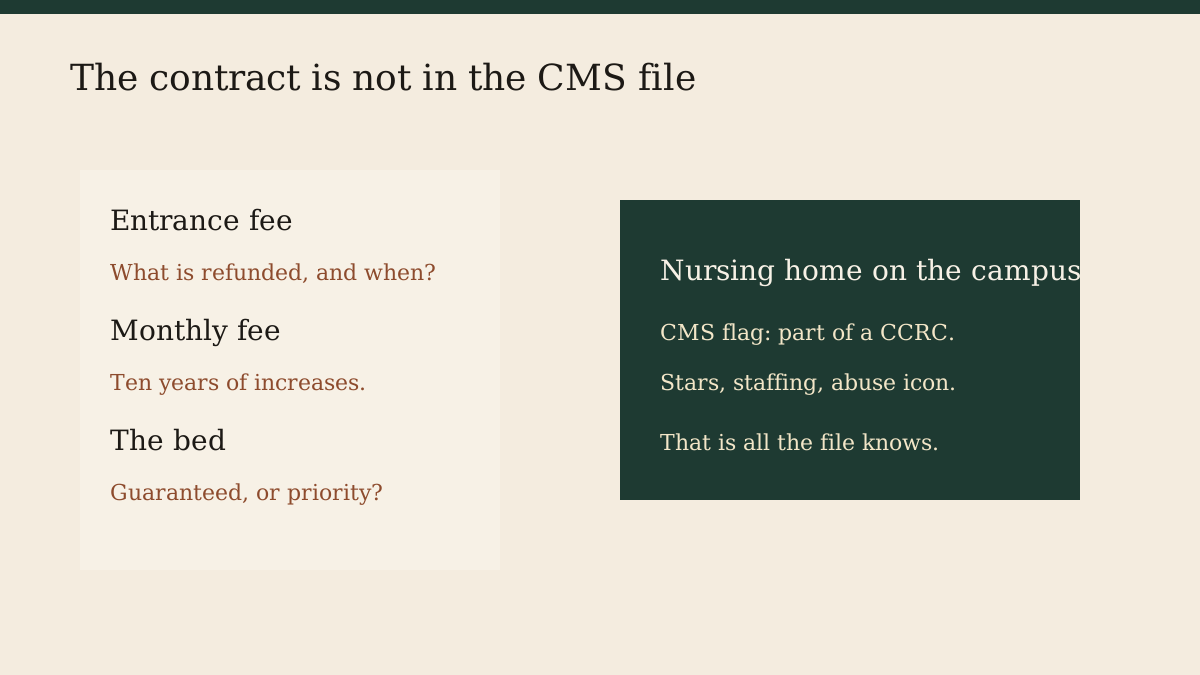
A continuing care retirement community, a CCRC, sells a story in one piece: you move into an apartment while you are well, and the campus will take care of you later, in assisted living or in the nursing home, without you having to go hunt for a bed in a crisis. Sometimes the contract really says that. Sometimes it says something much thinner, and the tour does the rest of the selling. The CMS file cannot tell those apart. It can only tell you whether the nursing home on the campus told Medicare it is part of a CCRC.
In the provider file we downloaded, processing date October 1, 2026, 1,548 nursing homes had that field set to yes. Our state tables show the flag on the row. A yes is the home’s report. It is not our review of the contract, not a promise that you will get a bed, and not a star. Read the contract, or pay a lawyer in that state who reads them for a living. This is the list of questions we would want answered before any entrance fee changed hands.
What kind of promise is this
Ask which type of contract they are offering, and make them point at the page. People in this business talk about Type A, Type B, and Type C. The labels are industry shorthand, not a federal form.
A Type A, often called a life-care contract, generally means a large entrance fee and a monthly fee that does not jump by the full cost of care when you move to assisted living or the nursing home. You are prepaying for future care. That can be a reasonable trade if the organization will still be here in twenty years and the contract says what you think it says.
A Type B, often called modified, prepays some care and then charges more, or charges the full rate after a certain number of days. The number of days is the whole deal. Find it.
A Type C, often called fee-for-service, gives you access to the campus and then charges you the going rate when you need care. The entrance fee may be smaller. You have not bought the future care. You have bought a place in line and a housing contract. That can still be what you want. It is not life care. Do not let a brochure use “life care” for a fee-for-service contract.
Some states regulate the life-care contract through the insurance department, because a promise to provide care for a prepaid fee looks like insurance. Ask whether this contract is filed with a state agency and which one. Ask for the disclosure statement that agency requires. If the state requires a disclosure and they do not have one, you are done.
The entrance fee and the refund
The entrance fee can be a large share of the sale of a house. Ask what you get back if you leave in month six, if you die in year three, and if you move to the nursing home and then leave the campus. Refund schedules are often declining, and some are “refundable” only after the apartment is resold to someone else. A refund that waits on a resale can take years. Ask whether your estate is in line behind the community’s lenders. Ask for the last three years of how long refunds actually took, not the best case in the marketing FAQ.
Ask what the fee is not. It is usually not buying you real estate. You may be buying a right to live there under a contract the community can terminate. That is closer to a very expensive lease than to a deed. Your lawyer should say which one it is in that state.
Monthly fees rise. Ask for the increase each year for the past ten years, in percent, and for the reason. Ask whether the monthly fee keeps rising when you are in the nursing home on a Type A contract. Ask what happens if you cannot pay. A contract that can evict you for nonpayment after you have sunk the entrance fee is a different risk from one that has a hardship fund. Get the hardship policy in writing. A verbal “we have never thrown anyone out” is not a policy.
The bed you are supposedly guaranteed
This is the question. Ask whether the contract guarantees a bed in the nursing home and a spot in assisted living, or whether it gives you priority on a waiting list. Priority is not a bed. Ask what “priority” means when ten contract holders need a bed and two are empty.
Ask whether the nursing home can refuse you for clinical reasons even after you have paid. A building can be within its license to say it cannot take a ventilator or a resident who hits. If the contract’s promise collapses at the moment of need, the entrance fee bought housing and a hope. Ask for the refusal criteria in the same document as the promise.
Then look up the nursing home on Care Compare and in our table. Read the stars, the staffing, and whether CMS has marked it a Special Focus Facility or put the abuse icon on it. You are deciding whether you want to be contractually pointed at that building. A beautiful apartment does not fix a one-star nursing home you will not be allowed to skip. If the nursing home is not in the CMS file, it is not a certified nursing home in the file we have, and the “health center” on the tour may be assisted living under a state license. Those are different buildings. Ask for both license numbers.
Health care you still have to arrange
A CCRC contract does not replace Medicare. Medicare still pays for hospital care, doctors, and a qualifying skilled-nursing stay under its own rules. The monthly fee and the entrance fee are not a Medigap policy unless the contract says, in insurance language, that they are. Most do not. You still need to decide about Medicare Advantage versus Original Medicare, and a campus clinic may be in one network and not another. Ask which Medicare arrangements the campus physicians accept. Call SHIP before you switch plans to match a clinic. Our SHIP guide is the warning about sales calls. Use it here too, because CCRC sales offices sometimes introduce an “advisor.”
Medicaid is the other collision. Some contracts require you to spend your own money, including the refund you might have gotten, before Medicaid, or they require you to remain private pay. Some nursing homes on CCRC campuses take Medicaid and some do not. Ask. If the plan is that Medicaid will eventually pay the nursing home, confirm the home participates and confirm the contract does not call that a default. This is lawyer territory. We are flagging it so you do not discover it in year twelve.
The organization’s money
Someone has to be solvent in twenty years. Ask for the audited financial statement and the occupancy rate of the independent-living apartments. Empty apartments mean entrance fees are not arriving to pay refunds to people who left. Ask how much debt the community has and what happens to residents if it is sold. Sales happen. The contract should say whether the buyer keeps the life-care promise.
Ask who regulates them besides the nursing-home surveyors. A state insurance department, a continuing-care statute, a housing agency. The disclosure those laws require is the document you read on a weekday, not in the sales gallery.
The Eldercare Locator will still be the way you find meals, rides, and the ombudsman if you live there and the contract is not the problem you actually have. The ombudsman covers the nursing-home residents and, in many states, assisted living. They do not rewrite your entrance-fee refund. Different tools.
What to do with our table
Use it to find the nursing home and to see the CCRC flag, the stars, the staffing, and the abuse icon CMS published. Then stop using it. The contract type, the refund, the monthly-fee history, and the bed promise are not in dataset 4pq5-n9py. They are in the packet the sales office would rather walk you through out loud. Take the packet home. Read the refund section twice. If you would not sign it without a lawyer, do not sign it with a nice lunch.
A last pass before any wire transfer
Read the rescission period. Some state continuing-care laws give you a few days to cancel after you sign and get the entrance fee back. If that right exists, the contract or the disclosure should say how many days and how to send the notice. Put the date on a calendar before you celebrate. If you are inside that window and the nursing-home star or the audited statement scared you, use the window. It is there because these contracts are hard to undo later.
Ask who you will actually deal with after the salesperson is gone: the name of the resident services director and the name on the disclosure as the provider. Google is not the check. The state agency named in the disclosure is the check. Call that agency and ask whether this community is in good standing and whether residents have a required meeting or resident association. A community that will not tell you which agency watches it is a community you can still walk away from.
Then stop collecting brochures. You either have the contract type, the refund math, the bed language, the nursing-home record, and a lawyer’s read, or you do not. The tour will not supply the missing piece. It already had its chance.