What an Area Agency on Aging actually does
Last updated
How the state unit, the Area Agency on Aging, and the Eldercare Locator fit together, and what those offices will not do for you.
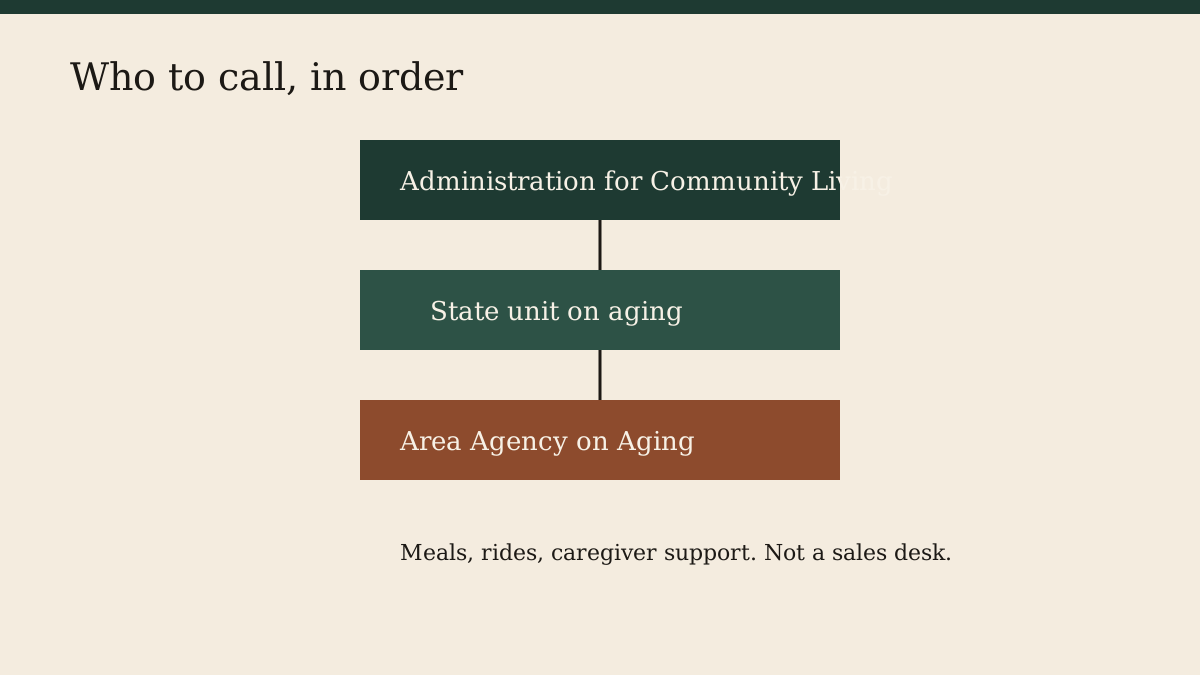
If you only remember one public office, remember the Area Agency on Aging. It is the local front door for a lot of the help that is not a nursing home and not a Medicare plan. Meals, rides, in-home help, caregiver respite, benefits screening, and a human who knows the county: that is the general idea. The name is awkward. The office is the one families find too late, after they have already paid a referral company to do a search the public system would have started for free.
Who sits above the local office
The Administration for Community Living, inside the Department of Health and Human Services, funds the aging network. ACL describes state units on aging as the state agencies that carry out the Older Americans Act. Every state, the District of Columbia, and the territories have one. The state unit plans, funds, and watches the local agencies. It is not, in most states, the place you call about a ride on Thursday. It is the place that decides how federal and state aging money is divided.
The local piece is the Area Agency on Aging. ACL’s page on those agencies describes them as the local planners and funders of services under the Older Americans Act. There are hundreds of them. Some cover one county. Some cover a whole rural state. Some are part of a council of governments. Some are nonprofits the state has designated. The name on the door may not even be “Area Agency on Aging.” It may be a council on aging or a county department. The Eldercare Locator exists so you do not have to guess which door.
The locator is a public service of the Administration for Community Living. The website is eldercare.acl.gov, and the phone number published there is 1-800-677-1116. You give a place, and they connect you to the local agency and to related programs, including the State Health Insurance Assistance Program when the question is Medicare. We link the locator from every state page because it is the one address that stays useful when a state redesigns its website.
On our state pages we also link the state unit’s own site when that site returned a normal page on November 20, 2026. A lot of state sites block automated checks or have moved. When we could not confirm an address, we left it off and said so. A wrong phone number is worse than a pointer to the locator.
What you can realistically ask them for
Call with an address and a plain description of the problem. “My father lives in this county, he is 82, he is not eating, and I live two states away.” That is enough. The agency’s information specialist, or the contractor they use, is supposed to know which local program fits.
Home-delivered meals and meals at a senior center are the famous ones. They are funded in large part through the Older Americans Act, and they are not unlimited. There can be a wait. There can be a suggested donation. The donation is not supposed to be the thing that keeps a poor person out. Ask, because local practice varies, and do not assume a private meal service and the public meal are the same pot of money.
Transportation is often a van to the doctor or the grocery store, not a taxi you can book in an app. Routes and eligibility are local. If the person uses a wheelchair, say so on the first call.
In-home help can mean homemaker service, personal care, or a short respite so a family caregiver can leave the house. These programs are not a substitute for 24-hour care, and they are not Medicare home health. Medicare home health is skilled care under a plan of care, for people who qualify as homebound. The Area Agency on Aging is the wrong office to approve that episode. It is the right office to tell you that you are describing Medicare home health and should talk to the doctor, or that you are describing a homemaker and should apply to the local program.
Caregiver support is its own track. The person on the phone should be able to point a spouse or an adult child toward respite, support groups, and sometimes a small grant for a break. If you are the caregiver, say that. Do not only describe the person who is ill.
Benefits screening is uneven but valuable. A good agency will help you see whether Extra Help with drug costs, a Medicare Savings Program, SNAP, or a property-tax relief program might apply. They are not the Social Security office. For a Social Security question, the official public door we can reliably point to from this site is USA.gov’s Social Security page, which routes you to the agency. SHIP is the Medicare counseling desk, and it is separate even when it shares a phone tree with the Area Agency on Aging.
The long-term care ombudsman is also in this network. The ombudsman helps residents of licensed long-term care facilities. The national resource center is ltcombudsman.org. If the problem is “the nursing home will not answer the call light,” that is an ombudsman problem. If the problem is “I need a ride so I can stay in my house,” that is an Area Agency on Aging problem. Families often have both at once. Ask for both.
What they will not do
They will not become your parent’s guardian. They will not move someone into a nursing home against the person’s will. They will not pick a Medicare Advantage plan and enroll you. That last one is SHIP’s lane only as counseling. SHIP does not sell the plan. A broker does. If the person who called you opened with a Medicare card and a limited-time offer, hang up and call SHIP. Our guide on that difference is blunt on purpose.
They are not a free version of a placement agency that tours five assisted-living buildings for you and then collects a fee from the building. Some Area Agencies on Aging keep lists of licensed facilities because the state asked them to, or because they run the ombudsman program. A list is not a ranking. If someone at a public agency pressures you toward one building, ask whether that building funds the agency. Older Americans Act services are not supposed to be a sales channel. You are allowed to ask.
They cannot invent capacity. Rural agencies cover huge counties with a small staff. You may get a voicemail. Leave the address, the phone, and the actual problem. Call the Eldercare Locator if you cannot find the local number. Do not pay a website fifty dollars for a “local specialist” before you have tried the public one.
How this site uses them
Every state overview links the Eldercare Locator, SHIP, and the ombudsman center, and the state unit when we could confirm the site. We do not list every local Area Agency on Aging with a phone number. Those numbers change, and the locator is the maintained front door. Publishing a stale local number next to a “verified” badge would be exactly the kind of thin directory this site is trying not to be.
If you already know the county, you can still start on our state page for the CMS and HUD records, then use the locator for the human help. The records and the agency answer different questions. The file tells you how many certified nursing homes are in the county and what CMS last published about them. The agency tells you whether your mother can get a meal while she is still at home. You usually need both, and you do not need a salesperson to introduce you to either.
How to make the first call shorter than an hour
Have the address, the county, the age, and one sentence about the problem. “She is 84, she lives alone at this address, she stopped driving, and she is not cooking.” That is a better opening than a medical history. Have a phone number that a stranger can leave a message on. Have a backup person they can talk to if you are at work. You do not need a power of attorney for an information call. You will need one, or the person’s own consent, before the agency can dig into someone’s benefits or medical situation. Ask what they need. Do not mail documents to a number you have not confirmed.
Ask three concrete questions before you hang up. Who provides home-delivered meals, and is there a wait? Who provides rides to medical appointments, and how far ahead do they book? Is there a caregiver respite program, and what does it actually cover in hours? Write the names. The first person is often a screener. The program is a contractor. You will get them confused if you do not write them down.
If the problem is a nursing home or assisted living that is already failing someone, ask for the long-term care ombudsman on the same call. If the problem is a Medicare letter, ask for SHIP. The Area Agency on Aging is the switchboard as much as it is the service. Using it that way is not a failure to “get help.” It is how the network was built.
Call the Eldercare Locator if you cannot find the local number, or if the local number rings to a fax. The published line is 1-800-677-1116, and the site is eldercare.acl.gov. Both are from the Administration for Community Living’s own service. We repeat them because a moved state website is a bad place to end a search. Our state page will add the state unit’s link when we could confirm it. The locator is the piece we trust every time.
Then, if you still need a building, use the CMS and HUD tables for what they are: certified nursing homes, home health, hospice, and the Section 202 layer. The agency will not have a secret better copy of those files. The files will not cook anyone dinner. You need both, and you can get both without paying a placement fee.