Senior centers, RSVP, and the other AmeriCorps Seniors programs
Last updated
Where a senior center usually gets its money, what RSVP and the companion programs are, and how to find a real local opening.
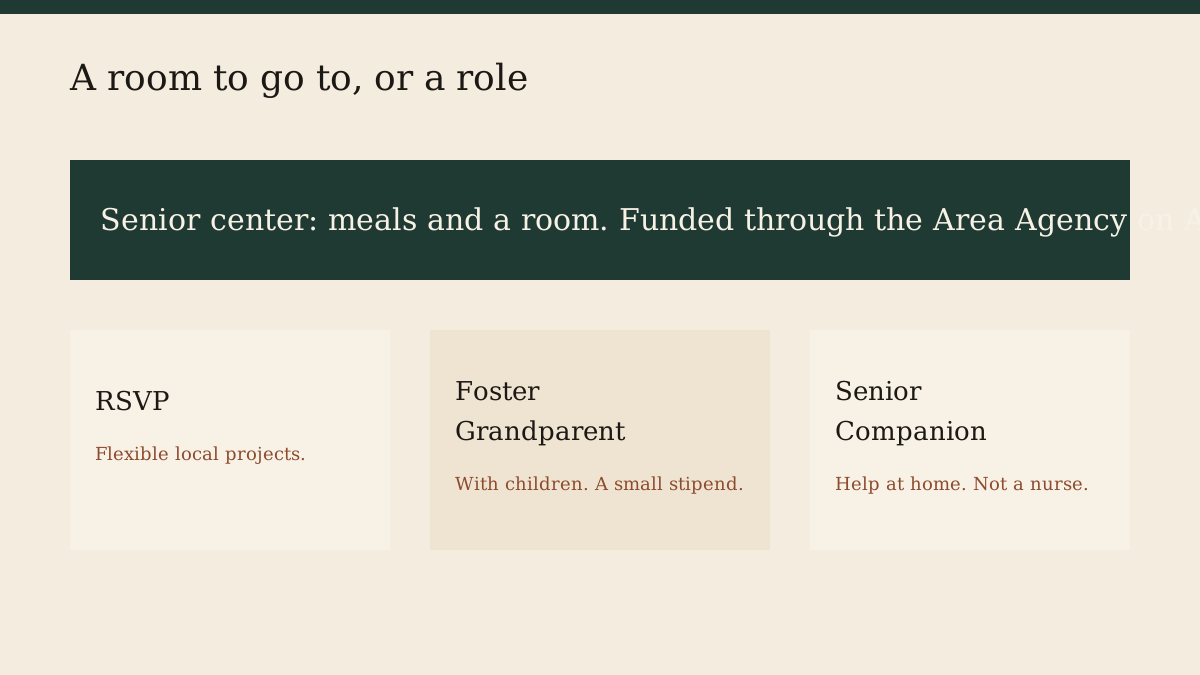
A senior center is often the first public room a person walks into after they retire, and almost nobody can tell you who pays for it. The answer is usually a braid: city or county money, Older Americans Act money that flows through the Area Agency on Aging, grants, and whatever the center can raise. The center is not a federal office with one national directory we could honestly scrape. AmeriCorps Seniors is a federal volunteer program with a real national home. The two get mentioned in the same breath because both are about staying useful and less lonely. They are not the same signup.
What a senior center usually is
A senior center is a local gathering place. Lunch, cards, a nurse checking blood pressure, a tax helper in the spring, a van in the parking lot. Some are run by a city parks department. Some are nonprofits. Some are the Area Agency on Aging’s own building. The Older Americans Act is the federal law that funds a lot of the meals and the supportive services you see there. ACL’s pages on state units on aging and on Area Agencies on Aging describe that funding chain. The state unit receives the federal aging money and passes much of it to the local agencies. The local agency contracts with centers and meal programs. That is why the center director talks about “Title III” if you ask where the lunch money comes from. Title III is the part of the Act aimed at nutrition and supportive services.
You do not apply to Washington for a seat at lunch. You call the center or the Area Agency on Aging. The Eldercare Locator, eldercare.acl.gov, will find the agency for an address. Ask for senior centers and for the meal program. Ask about a suggested donation. The donation is part of how these programs stretch money, and it is not supposed to turn a poor person away. If someone is turned away for inability to pay, that is a thing to raise with the Area Agency on Aging, not a thing to be embarrassed about.
A center is not a daycare for people who cannot be left alone, unless it is specifically a licensed adult day program. Those are different, often paid, and sometimes covered by Medicaid waiver in a given state. Ask what happens if a member starts to wander. A good center will tell you the limit instead of letting you discover it on a Tuesday.
AmeriCorps Seniors
AmeriCorps is the federal agency for national service. USA.gov’s agency page points at it, and americorps.gov is the agency site. AmeriCorps Seniors is the group of programs for older volunteers. The three names you will hear are RSVP, the Foster Grandparent Program, and the Senior Companion Program.
RSVP is the flexible one. Volunteers 55 and older do what a local project needs: food banks, disaster prep, tax help, mentoring. The stipend situation is not the point. RSVP is built as unpaid service with insurance and mileage support that varies by project. Ask the local project what they actually reimburse. Do not assume a wage.
Foster Grandparents work with children who need extra attention, in schools and child-care settings. There is an income test for the volunteer, and a small stipend, because the program is aimed at people who could not otherwise afford to give the hours. The stipend is modest. It is not a job, and it is not a substitute for Social Security. It is a way to be with kids and have the bus fare and lunch covered.
Senior Companions help other older adults with the ordinary work of staying at home: a ride, a walk, a check-in, a break for a family caregiver. Companions are not nurses and they are not home health aides. The line matters. If the person you love needs skilled care, Medicare home health or a paid aide is the answer. A Senior Companion is company and practical help from someone who is also older and who is supervised by a project. There is typically an income eligibility for the volunteer and a stipend, again modest.
Projects are local nonprofits, Area Agencies on Aging, and similar groups that hold the AmeriCorps grant. There is not one national shift you sign up for online and then get assigned a neighbor. You find the project that serves your county. The Area Agency on Aging usually knows who holds the grant. AmeriCorps’ own site is where you start if you want the national description and the current way they tell volunteers to apply. We are not listing every RSVP sponsor. Grant holders change, and a stale sponsor list is a page of wrong phone numbers.
Why the programs exist, in plain terms
Loneliness is not a soft topic once you have watched someone stop leaving the house. The public system has two answers that do not require a diagnosis. One is a room to go to, the senior center, with a meal that also lets someone see that you are all right. The other is a role, the volunteer programs, that asks you to be the helper instead of the person being helped. People will take the second when they refuse the first. Offer both. Do not call it activity for its own sake. Call it the way the Older Americans Act and AmeriCorps were built: to keep people in community on purpose.
There is also a practical pipeline. A Senior Companion or an RSVP volunteer is often the person who notices the empty mailbox and tells the project director, who tells the Area Agency on Aging, who gets a caseworker involved before a crisis. That is not surveillance. It is what a neighborhood used to do, funded just enough to keep happening.
How not to get hustled
A senior center that is free to walk into should not require a credit card “to register.” A suggested lunch donation is normal. A membership fee at a private club that calls itself a senior center is a business. Ask who the sponsor is.
An AmeriCorps Seniors project will not ask you to pay to volunteer. It will not ask for your Medicare number. It may ask about income if the program is Foster Grandparent or Senior Companion, because eligibility for the stipend depends on it. That question should come with a form from a named nonprofit you can look up, not from a person who direct-messaged you.
A “volunteer opportunity” that is really a timeshare seminar is not RSVP. RSVP projects can tell you their AmeriCorps grant. Ask.
We do not rank centers. We do not have a federal file of them that is complete. The locator and the Area Agency on Aging are the maintained path. Use them. If you want to be the person who helps, ask that agency who runs AmeriCorps Seniors in the county. If you want a place to eat and see someone, ask for the center. Both are public on purpose. You should not have to pay a referral site to be introduced to either.
A lunch program is not the same as adult day care
The meal at a senior center is a congregate meal funded, in many places, with Older Americans Act nutrition money. You show up, you eat, you see people. Adult day is a supervised day for someone who cannot safely stay home alone. It may be licensed. It may cost money. Medicaid may pay in some states through a waiver. A center director who blurs the two is creating a risk for you and for the other people at lunch. Ask which one they are. If you need the supervised day, ask the Area Agency on Aging what it is called in that county and whether there is a waiting list. Do not drop someone off at cards and hope.
Home-delivered meals are the other nutrition door. They exist for people who cannot get to the center. There is often an assessment. There is often a wait. A suggested donation is normal. Turning someone away because they cannot donate is not supposed to be. If it happens, tell the Area Agency on Aging, which is the funder in the chain ACL describes, not the person driving the van.
Showing up as a volunteer without wasting anyone’s week
Call the project before you promise a day of the week. RSVP shifts depend on a site that actually needs a person: a food pantry on Tuesday, a tax site in February, a school that has finished its background checks. Foster Grandparent and Senior Companion programs will ask about income because the stipend is for volunteers who meet a limit. Bring a sense of that number. You do not have to bring your tax return to the first phone call. You will need it before anyone promises a stipend.
Ask what training they provide and what you are not allowed to do. A Senior Companion should be able to say, out loud, that they do not give medications and do not replace an aide. If the project is fuzzy on that line, it is a project that will get a volunteer into a care situation they are not insured or trained for. Walk away from that one and ask the Area Agency on Aging for a different sponsor.
Background checks take time. Budget for them. A program that wants you in a school tomorrow and also wants your Social Security number by text is not the Foster Grandparent Program. AmeriCorps projects can tell you the name of the organization that holds the grant. Look that name up. Then go.
The point of both the center and the volunteer seat is the same and it is not cute. It is a reason to leave the house that other people are counting on. Use the public door. It was built for this.