SHIP counseling is not a Medicare sales call
Last updated
What the State Health Insurance Assistance Program is allowed to do, how to tell it apart from a broker, and where to look plans up yourself.
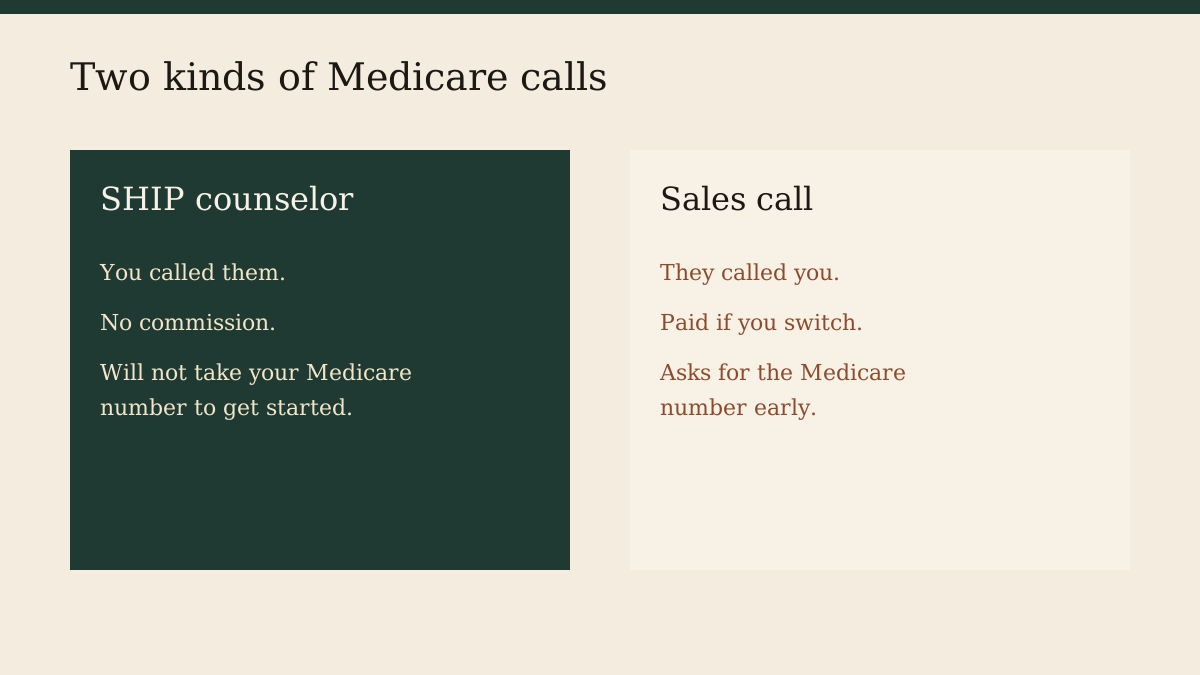
A stranger who calls about your Medicare is not SHIP. SHIP is the State Health Insurance Assistance Program, a grant-funded counseling service. The counselors are not paid a commission when you join a plan. The person on the unsolicited call often is. That single difference is worth more than any star rating on a plan commercial.
This site does not sell plans, does not collect Medicare numbers, and does not list agents. If you want a person, use the SHIP locator at shiphelp.org. If you want the federal explanation of how Medicare is structured, start at Medicare.gov’s “get started” pages. This guide is the difference between those doors and a sales pitch.
What SHIP is
SHIP is paid for with federal funds and run in each state, usually through the state unit on aging or an office next door to it. The national technical assistance center runs shiphelp.org, which is the directory of state programs. You pick a state and get the local program’s phone. You can also reach counseling through the Eldercare Locator, because the aging network and SHIP are built to hand people to each other.
A counselor can explain Original Medicare, Medicare Advantage, Part D drug coverage, and Medigap in ordinary language. They can sit with your drug list and your doctors and help you compare what is on Medicare.gov. They can explain a letter you do not understand. They can help with appeals paperwork at the level of “here is the form and the deadline,” which is not the same as being your lawyer. They can tell you about Medicare Savings Programs and Extra Help if money is the problem.
They do not enroll you in a plan in order to earn a fee. They do not cold-call you. They do not need your Medicare number in order to explain how Medicare works. If a counseling appointment is real, you called them, or you asked the Area Agency on Aging to connect you, or you walked into a library event they advertised.
What a sales call sounds like
It opens with urgency. The Annual Enrollment Period, or some other window, is “ending,” and you must act. It asks for your Medicare number early, sometimes before you have agreed that you want anything. It already knows a plan name. It says you will lose a benefit if you do not switch. It talks over you when you mention a doctor. It offers a “free” grocery card or a ride benefit as the reason to change your insurance, and it does not ask what drugs you take.
Medicare Advantage plans are allowed to advertise extra benefits. Those benefits have rules, networks, and years when they shrink. A counselor’s job is to put the grocery card next to the specialist you actually see. A salesperson’s job is to get an application. Both people can be polite. Politeness is not the test. The test is whether they are paid if you say yes.
Hang up if you did not ask for the call. You can also ask, “Are you with the State Health Insurance Assistance Program?” A broker who says yes is misrepresenting. Write down the phone number and the plan name if you want to report it. SHIP can tell you where complaints about marketing go. Medicare.gov is the other place, through the official contact paths on the site. Do not “verify” a caller by giving them the Medicare number they just asked for.
Original Medicare, Advantage, Part D, Medigap
You do not need a sales rep to know the four nouns.
Original Medicare is Part A and Part B, the federal hospital and medical insurance. Medicare.gov’s page on Original Medicare is the description. You can see any provider in the country who takes Medicare. That is the feature people miss when they move. It is also not a cap on your out-of-pocket costs. There is no annual maximum in Original Medicare the way Advantage plans have one. That is why Medigap exists.
Medicare Advantage is a private plan that replaces Original Medicare for the services the plan covers. You generally use the plan’s network. Extra benefits are plan benefits, not a federal entitlement that moves with you. If you move states, you usually cannot take the plan with you. The network was never national.
Part D is drug coverage, either as a stand-alone plan next to Original Medicare or wrapped inside an Advantage plan. The drug list is the part that changes your actual life. A counselor will ask for the list. A good salesperson will too. A bad one will skip it.
Medigap is a supplement policy that sits next to Original Medicare and pays some of the cost-sharing. It is not an Advantage plan. You generally cannot have both a Medigap and an Advantage plan. Medigap rules about when a company must sell you a policy vary by state and by your situation. Medicare.gov’s Medigap pages describe the federal framework. Your state insurance department is the local regulator. SHIP is the free explanation. We are not going to tell you which lettered Medigap plan to buy. The letters are standardized in most states, and the price is not. That is a conversation with a counselor who can see the state, not a paragraph from another state.
When people first get Medicare
Most people become eligible around 65. Some get it earlier through disability. The Social Security Administration handles a lot of the enrollment mechanics. From this site the reliable public door is USA.gov’s Social Security page, which points you to the agency. We do not link a pile of unofficial “Medicare enrollment” blogs. The official “get started with Medicare” page is the one that explains the windows. Missing a window can mean a late penalty that lasts. That is the kind of fact a SHIP counselor deals with every week, and the kind of fact a cold caller uses as pressure. The difference is what they want you to sign.
If you are still working and have employer coverage, do not assume you must enroll in Part B at 65. Do not assume you can wait, either. The employer plan’s size and whether it is based on current work are the details that matter. Write them down and take them to SHIP or to Social Security. A directory cannot see your paycheck.
How we handle Medicare on this site
Our state pages link shiphelp.org and Medicare.gov. They do not list agents, and they do not list Advantage plans. A plan list goes stale in a season, and a plan list with a “best” badge is an ad. CMS already runs Care Compare and Medicare.gov. We are not going to build a worse copy.
If a business ever buys a featured card on this site, it will be labeled as paid and it will not be allowed to look like a SHIP office. Checkout for those cards is off. Nothing on the state tables is a plan recommendation.
Use the counselor. Keep your Medicare number for people you called. And if the voice on the phone will not tell you who pays them, you already know.
What to have on the table before the appointment
Write down every prescription, the dose, and the pharmacy you use. A counselor cannot compare Part D plans against a memory. Write down the doctors you will not give up, and the hospitals you have actually used. Write down whether you are on Original Medicare or an Advantage plan now, and the exact plan name from the card. If you have employer coverage or a retiree plan, bring the summary that says whether it pays after Medicare or instead of part of it. Those booklets are dull and they decide whether you should enroll in Part B at all.
Write down your Social Security claiming status only so the counselor knows what you already did. The counselor is not Social Security. Changing a claiming age is a different office, the one USA.gov routes you to. Do not let one appointment blur into the other.
You do not need your Medicare number to learn how the program works. You may need it if you ask the counselor to look at a specific enrollment or a letter. Give it to the person you called, at the appointment, not to anyone who called you.
The calendars people mix up
Initial enrollment around 65, a special enrollment tied to leaving a job, and the fall Annual Enrollment Period are three different doors. The general enrollment period is a fourth, and it is the expensive one people use when they missed the others. Medicare.gov’s “get started” pages name the windows. A cold caller will name only the one that makes you hurry. Ask SHIP which window you are actually in, and what the late penalty would be if you wait. Get the penalty described as a percentage of the Part B or Part D premium, not as a scare.
Medicare Advantage and Part D can be changed in the fall window. Medigap generally cannot, except in situations the federal rules and your state define. People lose Medigap options because a salesperson moved them into Advantage and nobody said the supplement might not take them back without health questions. If you are even considering that switch, the sentence to say to SHIP is: “If I leave this Medigap policy, can I get it back?” Make them answer before anyone sends an application.
Bring a list of questions, not a hope that the counselor will pick your life for you. A good session ends with two or three plans written down, the pharmacies and doctors checked, and the extra benefits treated as extras. You enroll yourself, on Medicare.gov or with a method you understand. The counselor does not get a commission either way. That is the whole design. Use it.