Home health, hospice, and palliative care are three different things
Last updated
What Medicare actually covers at home, what you give up when you elect hospice, and why our hospice table has no stars.
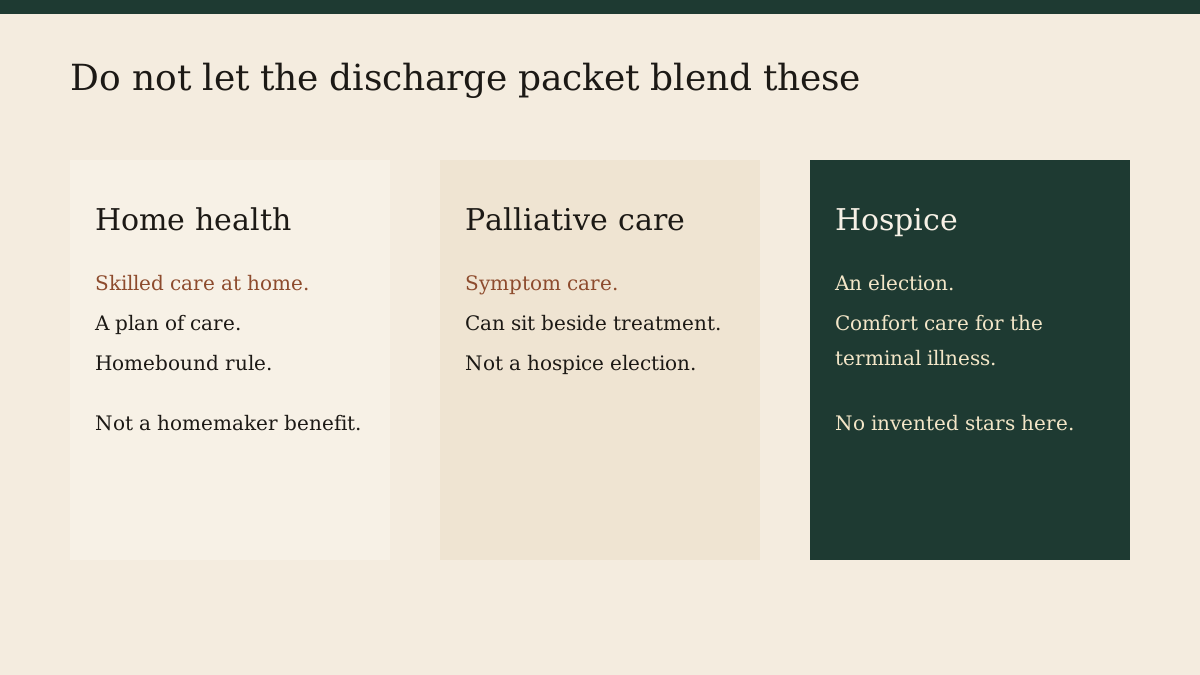
People say “home health” when they mean an aide who helps with a shower. Medicare means something narrower, and the difference is a stack of bills. Hospice is narrower still, and choosing it is a formal election, not a mood. Palliative care is a kind of medical care that can happen alongside treatment. The National Institute on Aging explains that last distinction in plain language, and it is the page we send people to when the words have been mashed together by a hospital discharge planner in a hurry. This guide is the practical version, tied to the files on this site.
Home health under Medicare
Medicare’s home health page is the rule. In short, you need to be under a doctor’s or allowed practitioner’s care, you need a plan of care they review, you need the agency to be Medicare-certified, and you need to be homebound in the way Medicare defines it. Homebound does not mean you never leave the house. It means leaving is a considerable and taxing effort, and your absences are infrequent or for short times, or for medical care. People argue about the edges of that definition. The argument is with Medicare’s rule, not with a sentence on our site. Read the coverage page and talk to the doctor who would sign the plan.
The services are skilled: nursing, physical therapy, occupational therapy, speech therapy, and, when those are in the plan, home health aide and medical social work. The aide is there to support the skilled care. Medicare home health is not a long-term homemaker benefit. If what you need is someone to cook and do laundry five days a week for a year, you are describing a different program, often Medicaid or an Area Agency on Aging service, and you should say that out loud so the discharge planner stops ordering a home health evaluation that will not solve it.
The agency has to be certified. Our state home-health tables are the CMS list, dataset 6jpm-sxkc, released October 21, 2026. The star, when there is one, is the quality-of-patient-care star in that file. In the national file a large share of agencies have no star. We print “Not published.” We do not average the measures ourselves to fill the hole. Care Compare has the measures underneath the star, including how often the team started care in a timely way and how often people got better at walking. Those measures are about episodes of skilled care. They are not a Yelp review of whether the aide was kind. Kindness still matters. It is just not the column.
A doctor you trust is the person who orders this. An agency that offers to “find a doctor to sign” so you can get free hours is a reason to slow down. Fraud in home health has a long public history. The SHIP counselor will not order the service for you, but they can tell you whether what you are being promised even sounds like the Medicare benefit.
Hospice under Medicare
Hospice is for someone whose doctor and the hospice doctor believe they have a life expectancy of six months or less if the illness runs its usual course, and who chooses comfort care for that illness instead of treatment meant to cure it. Medicare’s hospice coverage page is the official description of the election, the four levels of care, and what you might still pay. You sign an election. You can revoke it. You can change hospices. Those are rights, and they are also paperwork with dates. Ask the hospice to walk you through the election before the day you are exhausted.
Electing hospice generally means Medicare will not pay for curative treatment of the terminal illness, or for care related to that illness from providers outside the hospice arrangement. Care for other problems can still be covered under the usual Medicare rules. This is the sentence families mishear as “Medicare stops.” It does not stop. It changes who manages the terminal illness. The National Institute on Aging page is calmer about this than most hospital printouts. Read it when you are not in the hallway.
Hospice can be at home, in a hospice facility, or in a nursing home. If the person lives in a nursing home, the room and board may still be private pay or Medicaid. Hospice does not automatically pay the nursing-home rent. Ask that question in dollars, not in vibes.
Our hospice tables are the CMS general-information file, dataset yc9t-dgbk, released November 20, 2026. That file has names, addresses, phones, and ownership. It does not have the quality stars or the quality measures. We did not invent stars to fill a column. Care Compare is where CMS posts measures such as whether the team visited in the last days of life. Open it. The city in our table is the office address. A hospice can serve a wide radius. Ask which counties they actually staff at night, not which counties the brochure shades in.
Ownership matters only as a fact. For-profit and nonprofit hospices both exist in the file. We do not treat one as cleaner. We show the field CMS recorded. If you want to know how a particular hospice behaves, the Care Compare measures and the families you can actually talk to will tell you more than the ownership word.
Palliative care
Palliative care is specialized medical care for the symptoms and stress of a serious illness. It can be given with curative treatment. You do not have to stop chemotherapy to see a palliative clinician. You do not sign away Medicare. The National Institute on Aging describes it as a team approach to pain, nausea, breathlessness, and the decisions that go with them. It is often based at a hospital or a clinic. It is not a benefit you “enroll in” the way you elect hospice, though a particular program may have its own intake.
Medicare may pay for palliative visits the way it pays for other doctor visits, under Part B, with the usual cost sharing. There is not a separate “palliative care benefit” page on Medicare.gov that we could find that stands next to the hospice page, and we are not going to link a URL that 404s. If a program tells you palliative care is free because it is hospice, they are mixing the words. Ask which one they are offering, and ask what you would be signing.
A useful question in the hospital: “Is this palliative care while we keep treating, or are you asking us to elect hospice?” Make them answer with one of those two. Write it down. The discharge packet can say both in the same paragraph.
How to choose without a billboard
For home health, start with the doctor, then look at agencies that serve the address, then read the star and the measures on Care Compare. Ask how fast they start. The measure about timely initiation exists because starting late is a known failure. Ask who comes on the weekend if a catheter is a problem on Saturday. Our table cannot see Saturday.
For hospice, ask who visits, how often, and who is on call. Ask what “continuous care” and “inpatient respite” mean in their operation, not as definitions you can already read on Medicare.gov. Ask what they will do about pain at 1 a.m. Ask whether they will talk to the nursing home if that is where the person lives, and who pays the room. Then look at the Care Compare measures. A hospice that will not give you time for those questions is telling you something.
For either one, SHIP is the right desk if the confusion is about what Medicare pays. The Area Agency on Aging is the right desk if the need is a homemaker, a meal, or a volunteer sitter. The ombudsman is the right desk if the person is already in a facility and the care is the problem. Three phones, three jobs. The billboard that offers all three plus a free book is a lead form.
We will keep the tables tied to the files, with the dates, and we will leave the stars off the hospice list until CMS puts them in the file we are copying. An empty star cell is more honest than a number we made up to look finished.
The numbers in the files, so the blanks make sense
The home health file we downloaded lists 12,399 agencies in the states, the District of Columbia, and Puerto Rico. Only 459 of them have a five-star quality-of-patient-care rating in that file. 166 have one star. 8,376 have no star at all. That last number is why a table full of “Not published” is not a broken page. CMS did not calculate a star for those agencies in this extract, often because the agency was new, small, or missing the data the formula needs. Care Compare will sometimes show the footnote that our column does not have room to repeat. Click through.
The hospice general-information file lists 6,464 hospices in the same places. Zero of them have a star in that file, because the file is names, addresses, phones, and ownership. Quality measures live on Care Compare, one hospice at a time. If you want a single number, you will have to read the measures. We will not average “visits in the last days of life” into a fake star so the table looks finished.
A practical way to use both lists: pick two agencies that serve the address, open both Care Compare pages, and write down one measure you understand. For home health, timely start of care is a fair one. For hospice, visits at the end of life is a fair one. Then call and ask them to explain their own number. A straight answer sounds like a person who has read the report. A sales answer sounds like a brochure.
One more split that discharge planners blur: palliative care can be billed as ordinary doctor visits while treatment continues. Hospice is an election. If the packet uses both words, make someone say which signature they want. Take that sentence to SHIP if the money part is still muddy. The counselor is not the one admitting you. The counselor is the one who will tell you what the signature does to the rest of Medicare.