Questions worth asking on a nursing home visit
Last updated
What to look at in the hallway, what to ask the charge nurse, and which CMS fields to have open on your phone before you go.
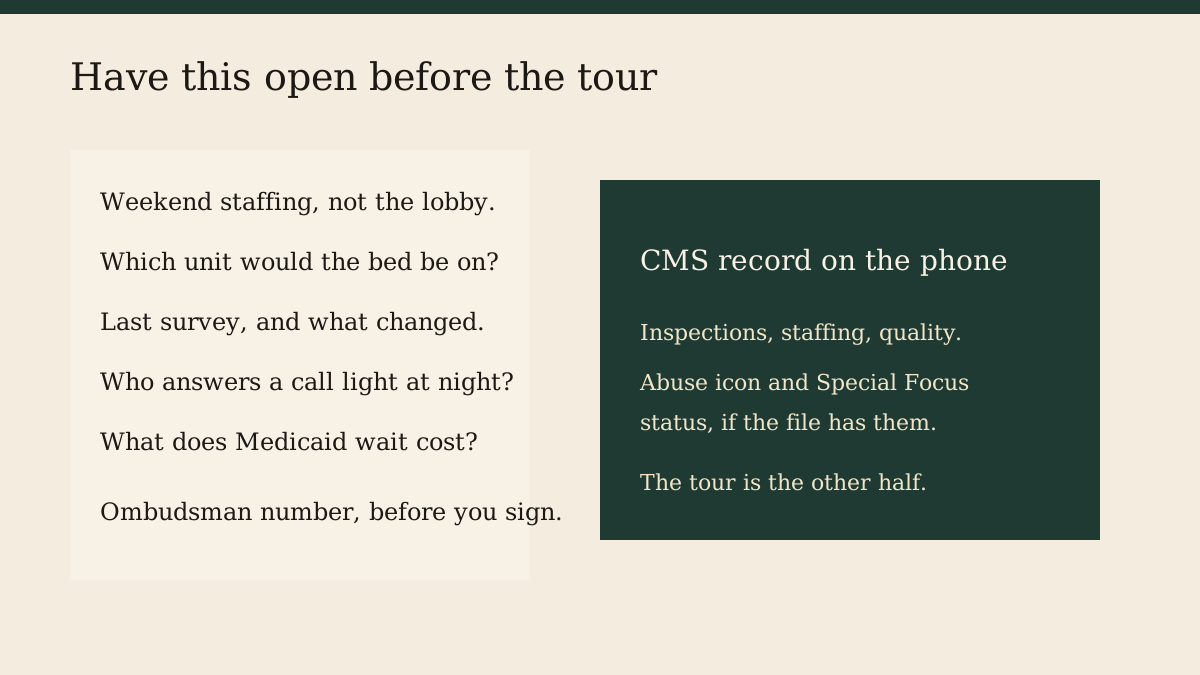
A tour is a performance. The room they show you has been prepared, the staff on the tour have been told you are coming, and the hallway you are steered down is the calm one. You can still learn a lot if you arrive with the CMS record open and with a few questions you are willing to ask twice. The visit checklist on this site is the short version you can tick on your phone. This is the reason each line is there.
None of it picks the home for you. A building can answer well and still be the wrong medical fit. A building can be tired and still be the one your father will accept because his friends are there. The questions are how you find out which of those you are looking at.
Before you drive
Open the home on Care Compare. Read the three stars separately: inspections, staffing, quality measures. If you use our table, the same numbers are the ones from the October 2026 provider file, and Care Compare is the newer page if they disagree. Note whether the abuse icon is on and whether the home is a Special Focus Facility or a candidate. In that file, 87 homes are marked SFF and 440 are candidates. If this home is one of them, you are not on an ordinary tour. Call the long-term care ombudsman first. The national center at ltcombudsman.org will point you to the local one. Ask what families have been complaining about. You are allowed to walk in already knowing.
Write down the weekend nurse staffing figure if the file has it, and the date of the last standard survey we show. You are going to ask a human what those numbers mean. A number you have not written down will get explained away.
Call ahead, but not so far ahead that only the show unit is staffed. A day’s notice is enough to be polite and not enough to repaint.
On the unit, not in the lobby
Ask to see the unit where the bed would actually be. If they will only show a rehab wing and your mother needs long-stay dementia care, you have not seen the relevant floor. Walk it at the speed of a person who lives there. Count call lights that are on. You do not need a stopwatch to notice a light that stays on while you have a whole conversation. Ask who answers a light at night, and how many aides are on that shift tonight, not “typically.”
Smell is information. Urine that has soaked in is a staffing and housekeeping fact. A strong floral spray is also information. Kitchens smell like food at meal times. If it is noon and you cannot tell a meal happened, ask where people eat and whether anyone helps the people who cannot feed themselves. Watch one meal if they will let you. The quality measures include things like weight loss and pressure ulcers for long-stay residents because those are the harms that show up when help does not arrive. You cannot diagnose an ulcer on a tour. You can see whether help with eating is real.
Ask to speak with a resident who is not pre-selected, or with the resident council president. The provider file notes whether a home has a resident and family council. A council that meets is a sign that someone is allowed to complain in an organized way. Ask when they meet and whether a family member can come. If the tour guide has never heard of the council, that is an answer.
Look at the faces of the aides when a supervisor is not in earshot. You are not conducting a survey. You are noticing whether people look like they can speak. Ask one aide how long they have worked here. Turnover is part of the staffing star for a reason. The users’ guide uses six quarters of Payroll-Based Journal data to measure it. A hallway where nobody has been there a year is the same fact in street clothes.
Questions that have to be answered in numbers
How many nurses and aides are on this unit on the day shift, the evening shift, and the night shift? How does that change on Saturday? What is the current number of residents on the unit? You are building a ratio the star already tried to build, and you are checking whether the star matches this floor.
What was the last standard survey, and what was the most serious deficiency? What did you change? A home that says “we’re five stars, so nothing” has not read its own report. Even good homes get citations. You want the ones who can describe the fix.
Who is the medical director, and how often is a physician or nurse practitioner actually in the building? Who do you call at 8 p.m. on Sunday when someone has a fever? If the answer is “we send everyone to the ER,” ask how often that happens. Hospitalization rates show up in quality measures because bouncing a resident to the hospital is sometimes necessary and sometimes a substitute for care.
What does Medicare pay for, and what will we pay? Read Medicare’s nursing-home coverage page before you go so the answer has something to bump against. A skilled stay after a hospital is not a long-term Medicaid bed. Ask whether they have a Medicaid bed and how long the private-pay period is before you can apply. Get the number of months in writing. This is the question that decides whether the building is financially possible, and tours are designed to postpone it.
If you are looking at memory care inside a nursing home
Ask whether the unit is secured and how they handle someone who tries to leave. Ask about the overnight staffing on that unit specifically. A building-wide staffing average can hide a locked unit with one aide. Ask what training the aides get on dementia, and who gives it. Ask what they do about a resident who hits. Chemical restraint and physical restraint have a long ugly history in this setting. A careful home will talk about behavior, pain, and staffing before it talks about medication. A sloppy one will talk about medication first.
The CMS star is still about the certified nursing home, not about a brand name painted on the unit door. Our memory-care guide covers the assisted-living version of this question, which is a state license and not a star.
After you leave
Write down what you saw before you talk yourself out of it. Compare notes with the person who will do the night visits, because you will not be there at 8 p.m. and they might. Call the ombudsman if the tour and the CMS record disagree in a way that scares you. A Special Focus designation, an abuse icon, or a one-star inspection is not automatic disqualification if you truly have no other option within reach of the family. It is a reason to know the ombudsman’s name before move-in day.
Do not sign anything the day of the tour if someone tells you the bed will vanish at 5 p.m. Beds are real and scarce. Pressure is also a sales tactic. You can ask them to email the admission packet. Read the arbitration clause. You can often decline pre-dispute arbitration. That is a legal choice, and if you do not understand the clause, do not sign it on the hood of a car.
The record is the homework. The hallway is the test. Neither one is the whole decision, and both are better than the brochure that got you in the door.
Bring a second person, and give them a job
One of you talks. The other writes down the staffing numbers, the names, and the things that do not match the CMS page. It is very hard to do both while also being polite. The writer should note the time you arrived and the unit you were allowed to see. If you were kept in a conference room for forty minutes, that is a fact. If a call light stayed on through the whole conversation, that is a fact. You will not remember either one accurately after you have talked yourselves into liking the building.
Switch roles if you can stay for a meal. The person who is not eating watches the dining room. Who is being helped. Who is asleep in front of a tray. Whether the staff talk to the residents or only to each other. You are not scoring them. You are collecting a picture you can compare with the next building, where the tour will also be charming.
Paper you should not sign in the lobby
The admission packet is a contract. Arbitration clauses, responsibility for charges the payer denies, and the rules for discharge all live in it. Ask them to email it. Read the part about what they do if Medicare stops paying and the part about when they can make you leave. You can often refuse a pre-dispute arbitration agreement and still be admitted. If they say you cannot, ask them to show you the line in the law. If you do not understand the clause, do not sign it because the bed feels urgent.
Ask for a copy of the resident’s rights the state requires them to give you. The rights are not a decoration. They are what the ombudsman uses when something goes wrong. Put the ombudsman’s number on the fridge before move-in day, not after the first bad night. If the home is a Special Focus Facility, or the abuse icon is on the CMS page, make that call before you sign. You can still choose the building. You should not choose it as a surprise.
When you get home, compare your notes with the Care Compare page one more time. If the weekend staffing they described and the weekend staffing in the file are different species, email the home and ask them to reconcile it. A written answer is worth more than a tour guide’s confidence. Keep it with the packet.