What actually changes when you retire to another state
Last updated
Medicare mostly travels. Medicaid, Medigap, property taxes, and your doctors do not. How to sort the list before you move.
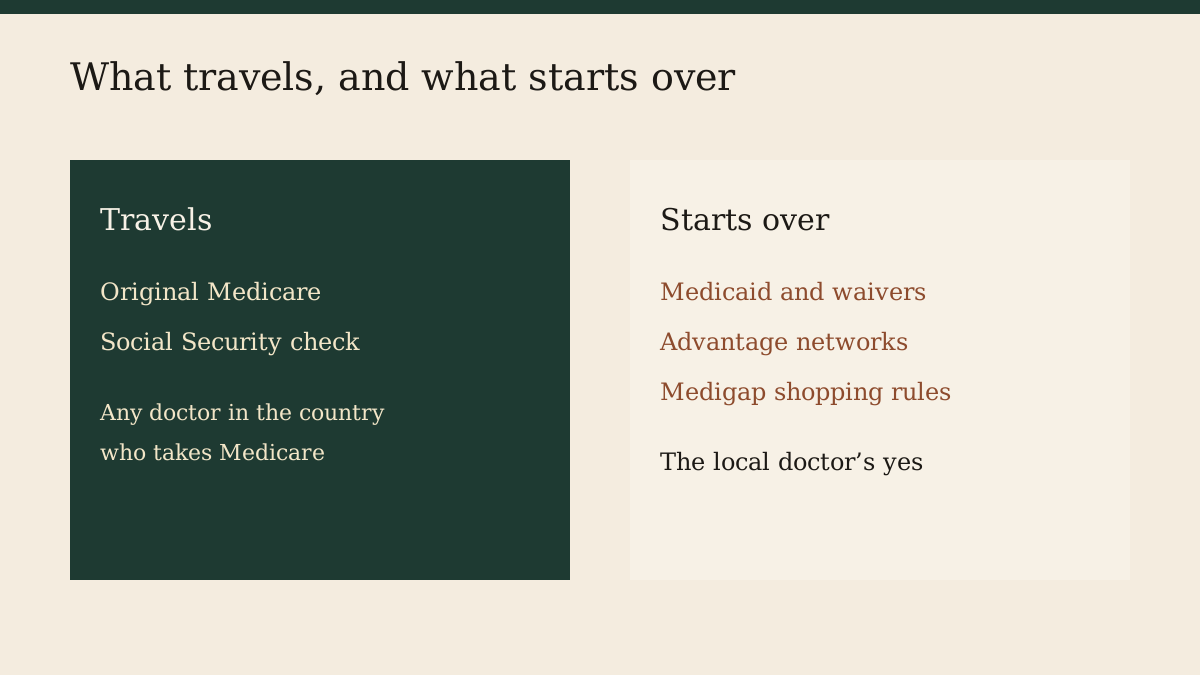
The fantasy is that you pick a state from a chart of taxes and weather and your life relocates cleanly. Some things do travel. Original Medicare does. Your Social Security check does. A lot of the rest is local, and the local part is the part that strands people: a Medicare Advantage network that ends at the state line, a Medicaid waiver that does not transfer, a doctor who is not taking new Medicare patients, a house that looked cheap until the insurance quote arrived.
This is not tax advice and not a ranking of states. Our comparison tool will put Census age counts and CMS file totals side by side. Those totals are not a reason to move. They are a way to see that one state has more certified nursing homes because it has more people. Florida’s civilian 65+ population in the Vintage 2025 estimates is 5,346,788. Utah’s is 460,179. Of course the nursing-home counts differ. That is not a quality finding.
What moves with you
Original Medicare, Part A and Part B, is federal. Medicare.gov describes it as coverage you can use with any provider in the country who accepts Medicare. If you are on Original Medicare and you move, you do not “transfer” it. You still have it. You tell Social Security your new address. USA.gov’s Social Security page is the public door to the agency that keeps that address. Your check follows you. Your Part B premium still comes out of it.
A stand-alone Part D drug plan is not national in the way people hope. Plans have service areas. A move is a chance to pick a new drug plan. SHIP in the new state is the free help. Do this before you need a refill in the new town and discover the pharmacy is out of network.
Medigap is the messy one. A policy you already have may be usable with any provider who takes Medicare, because it supplements Original Medicare rather than building a network. Whether you can buy a new policy in the new state, at what price, and with what health questions, depends on the state and on your situation. Medicare.gov’s Medigap pages are the federal overview. They are not a quote. Call SHIP in the destination state before you sell the house. A surprise medical underwriting questionnaire is a bad thing to meet after the moving truck is booked.
What does not move
Medicare Advantage is a local plan. The network of doctors, the extra benefits, and often the plan itself are tied to a service area. When you move out of the area you generally get a special enrollment period to pick something else. “Generally” is doing work in that sentence. Confirm the window with SHIP or with Medicare, and do not take a broker’s urgency as the calendar. The plan you loved will not follow you to a county where it has no contract.
Medicaid does not travel. Each state runs its own program, with its own income rules and its own waivers for home care and assisted living. If someone is on Medicaid, or is about to spend down to it, a move can mean losing the waiver slot and starting over, including a new look at the house you just bought. This is the fact that should stop a casual relocation of a parent who is already in a Medicaid nursing-home bed. Talk to the destination state’s Medicaid office and to a lawyer who does elder law in that state before you move the person. We are not that lawyer, and we do not publish Medicaid income limits because we will not be first to notice when a legislature changes them.
Doctors are local. Accepting Medicare is not the same as accepting new patients, and it is not the same as being in an Advantage network. Call the clinic in the new town and ask both questions. A five-star nursing home is irrelevant if what you need is a cardiologist.
Property taxes, homestead exemptions, and senior freezes are state and county law. The assessor’s office is the source. A blog that ranks “best states for retiree taxes” is compressing income tax, sales tax, property tax, and tax on retirement income into one trophy. Those are four different bills. Read the state department of revenue’s own page, and remember that a no-income-tax state can still tax a house hard. We do not rank states on taxes. We do not have a file that would make the ranking anything but an opinion.
Long-term care insurance policies often pay regardless of state, under the policy’s definitions of care. The policy is the source. A facility that qualifies in one state may use a license name the policy does not recognize. Ask the insurer, in writing, whether the building you are considering counts.
The public offices to call in the new state, in order
Call SHIP in the destination state before you call a real-estate agent back. shiphelp.org has the state programs. Ask about Advantage, Part D, and Medigap in that state. Bring your drug list and your doctors’ names.
Call the Eldercare Locator with the new address and ask for the Area Agency on Aging. Ask what help exists if you age in place there: meals, rides, caregiver support. You are interviewing the county, not only the house.
If a parent may need a nursing home, look at our state table and then at Care Compare. The inspection star is scored inside that state. Do not compare it to the star in the state you are leaving and declare a winner. Staffing stars are the ones CMS builds on a national curve. Even those do not know whether the building has a bed.
If subsidized rent is the plan, use the HUD Section 202 layer and then call the properties. Waiting lists do not transfer from your old town.
Tell Social Security the new address. Update Medicare so the plan mail goes to the right porch. Register to vote if you want to. That last one is the secretary of state, and it is not our page.
What our numbers will not decide
The comparison tool shows, for two states, the civilian population 65 and older, the share of the population that age represents, nursing-home counts and star counts from the CMS file, home health and hospice counts, and the HUD layer count. The share is a composition fact. Maine’s older share is higher than Utah’s in the Vintage 2025 file. That does not make Maine a better place to be 70. It means more of the people who live there are already older, which affects politics, health systems, and how many grandchildren you will see at the grocery store. It is not a happiness score.
Weather, grandchildren, and whether you can afford the house after insurance are the actual reasons people move. The public records are how you avoid discovering, in month three, that the plan, the waiver, and the doctor did not come with the furniture.
Move the Medicare questions to SHIP. Move the parent-on-Medicaid questions to a lawyer in the new state. Use the files for what they count. Leave the trophy charts to the people selling the houses.
A sequence that keeps the boring things from becoming emergencies
Six months out, if you can: call SHIP in the destination state with your drug list and the names of the doctors you hope to keep or replace. Ask whether your Advantage plan even exists there. Ask what a Medigap policy costs at your age in that state if you are on Original Medicare and might need a new supplement. Write down the enrollment window they describe, and the date you would have to use it.
Then call two clinics and ask if they take new Medicare patients, and whether that answer changes if you are on the Advantage plan you might join. A yes on Original Medicare and a no on the plan is a common pair. It should change which plan you pick, not which clinic you pretend will work.
Three months out: ask the destination Area Agency on Aging, through the Eldercare Locator, what exists for meals, rides, and caregiver support at the address you are actually considering. A pretty town with no van and a two-year waiver wait is a fact you can still use. Ask the Medicaid question if a parent’s care is part of the move. If the answer is “you start over,” believe it and talk to a lawyer in that state before you list the house.
One month out: tell Social Security the date and the new address. Set up the drug refills so you are not transferring a prescription in the same week the truck arrives. Update the Medicare mailing address. Register the car and the voter registration on the schedules those states publish, not on a blog’s “best of” list.
After you arrive: open Care Compare only if you need a nursing home, home health, or hospice. Open our state page if you want the file counts and the public phones we could verify. Do not use the share of residents over 65 as a score. Maine is older, as a population, than Utah in the Vintage 2025 estimates. Both can be the right place. The right place is the one where the plan, the doctor, and the help still exist on a Tuesday.