How to check a retirement planner without hiring us to do it
Last updated
Where CFP Board, NAPFA, the SEC, and FINRA each fit, and why this site will not print a list of advisers.
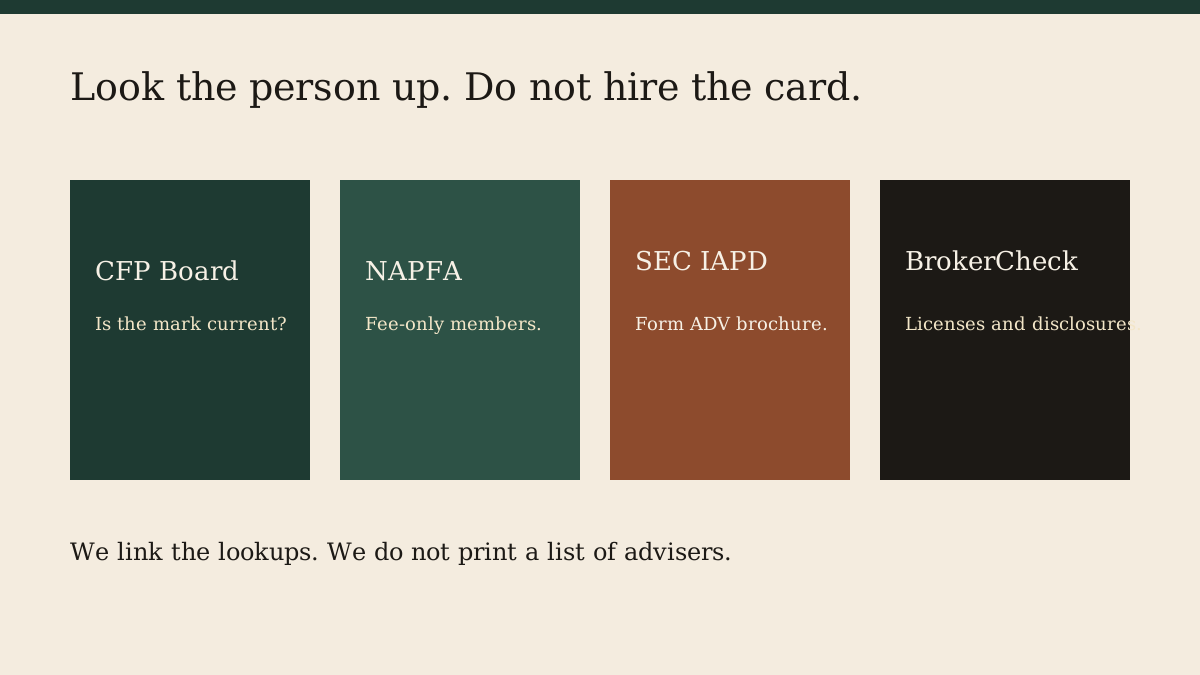
A retirement planner is not a license you can look up in one federal database the way you look up a nursing home. The title on the business card may be unregulated. “Senior specialist” is a mood. The checks that mean something are narrower: a certification with an ethics code, a registration as an investment adviser, a brokerage license, and the public record of discipline. This site links those checks. It does not copy the directories, and it does not name a person we think you should hire. Naming people would go stale, and it would turn us into the thing we are telling you to be careful of.
Four doors, four different questions
CFP Board lets you verify that someone is a CFP professional. The mark means the person passed the certification requirements and is subject to the Code of Ethics and Standards of Conduct. The code includes a fiduciary duty when the person is doing financial advice. Verify the mark on CFP Board’s own site. A logo on a website is not the verification. People let certifications lapse. The lookup is the current fact.
NAPFA is the National Association of Personal Financial Advisors. Its directory is fee-only planners who meet NAPFA’s membership rules. Fee-only means the person is paid by you, not by a commission on a product. That is not the same as “fee-based,” a phrase that can include commissions. Ask which one, and ask for it in writing. NAPFA’s directory is NAPFA’s. We link it. We do not reprint it.
The SEC’s Investment Adviser Public Disclosure site, adviserinfo.sec.gov, is the public file for registered investment advisers. This is the important one if someone manages money. An adviser who registers files Form ADV. Part 2 is a brochure in plain-enough language that covers services, fees, conflicts, and disciplinary information. Read it. Search the person’s name and the firm’s name. A firm can be registered when the individual you met is not the one with the discretion. See who has the authority. State-registered advisers are on the same site. If you cannot find the firm at all, ask why they are giving investment advice without a registration you can see. There are exemptions. A straight answer names the exemption. A vague answer is a reason to leave.
FINRA BrokerCheck is the record for brokers, the people licensed to sell securities. It shows employment history, licenses, and disclosures such as customer complaints and regulatory actions. A disclosure is not a conviction. It is a reason to read. Many people are both a broker and an investment-adviser representative. They may wear the fiduciary hat for the advisory account and a different standard for the brokerage account. Ask which account they are recommending, and which standard applies to that recommendation. If they cannot answer without a metaphor, you are not ready to sign.
What to ask, in an order that saves time
Ask how they are paid, before you ask what they think of the market. Fee from you, commission from a product, or both. Ask what a year of their help costs in dollars on a portfolio the size of yours, not in basis points you have to translate at home. Write the number down.
Ask whether they will be a fiduciary for the advice they are about to give you, and for which accounts. The CFP Board standard applies to CFP professionals. The Investment Advisers Act framework applies to registered advisers. A broker’s obligations are the ones FINRA and the SEC describe for brokerage. We are not going to paraphrase those standards into a slogan. The public documents are the standard. A planner who says “everyone is a fiduciary now” is flattening a real distinction. Make them point at the account.
Ask for the Form ADV brochure if they manage money, and read the conflicts section. Proprietary products, referral fees, and custodians that pay the firm are normal enough to be disclosed and important enough to understand. Ask who has custody of the assets. The money should sit at a well-known custodian in your name, not in the planner’s operating account. This is the check that prevents the oldest fraud in the business.
Ask what they will not do. A good planner will tell you to talk to SHIP or to Medicare.gov about health insurance, and to Social Security about your claiming age, instead of guessing. USA.gov’s Social Security and retirement pages are the public doors. The Consumer Financial Protection Bureau has retirement tools that are built for consumers, not for leads. Use those before you pay anyone to explain what Social Security’s own site will show you for free. A planner earns their fee on the parts the government will not personalize: whether to pay down the house, how to draw from which account, what a pension option is worth, how a spouse is protected.
Red flags that do not require a law degree
They lead with a product. An annuity can be a reasonable tool. It is not a plan. If the first meeting is a seminar at a steakhouse and the second meeting is a signature, you are in a sales sequence. Eat if you want. Do not bring the financial statements.
They use “senior” as a credential. Designations with the word senior in them range from serious coursework to a weekend. Look the letters up. If you cannot find an independent body that can discipline the person for misusing the letters, the letters are decoration.
They do not appear in BrokerCheck or the SEC site, and they also cannot explain why. Unregistered advice about securities is a problem. Advice that is only about budgeting may not require registration. The line is the line they should be able to draw out loud.
They want you to name them as a trustee or a power of attorney in the first month. That is a different relationship, with a different kind of risk. It can be appropriate years later with a lawyer involved. It is not an opening offer.
They bad-mouth Social Security or Medicare as a way to rush you into a private product. Both programs are complicated and both are real. SHIP and the Social Security office are free. Pay a planner to coordinate, not to replace the agencies.
Why you will not find advisers listed here
A list of “best retirement planners in the state” is a magnet for anyone who will pay to be on it, and a trap for us if we pretend we interviewed them. CFP Board, NAPFA, the SEC, and FINRA already run the lookups, and they update them when someone is disciplined. We would be a worse copy by the following Tuesday. Our state pages link the four sites and stop.
If we are wrong about a link, tell us. If we are wrong about a person, we were wrong to have named them, and we will not start. Your check is the public file. Read it before you move the IRA.
What a useful first meeting produces
You should leave with paper. A one-page description of what they will do, what they will not do, how they are paid, and what the first year costs in dollars. If they manage money, the Form ADV brochure. If they sell securities, the BrokerCheck report you pulled yourself, not a printout they handed you. If they hold a CFP mark, the verification you ran on CFP Board’s site while you were still in the parking lot.
The scope should say whether they will recommend specific investments or only a general allocation. It should say whether tax returns are in or out. It should say that Medicare and Social Security decisions get checked against Medicare.gov, SHIP, and Social Security, not invented in the meeting. USA.gov’s retirement page is a reasonable public map of those federal benefits. It is not a plan. A planner who will not write the scope down is asking you to remember a sales conversation. Do not.
A second meeting is reasonable. A same-day signature on a transfer form is not, unless you already knew what you wanted and this person is only the paperwork. IRA and 401(k) rollovers are where people get stuck in products they cannot leave without a penalty. Ask what it costs to get out in year one, year three, and year seven. If the answer is a surrender charge that lasts longer than the planner’s promised relationship, you are buying a product, not advice.
Conflicts that are ordinary and still your problem
Referral fees between a planner and an estate lawyer, an accountant, or an insurance agent are common. They belong in the ADV brochure or in a plain sentence you ask for. A fee paid by the product company to the person recommending the product is the conflict that matters most. Annuities, proprietary mutual funds, and some insurance-wrapped accounts are built that way. The product can still be right. You cannot tell if you do not know the fee.
Custody is the other ordinary fact that prevents theft. The statement should come from a custodian you can call, in your name, and it should match what the planner says you own. If the only statement is on the planner’s letterhead, stop. That structure is how small frauds survive until the custodian-shaped hole is obvious.
We are not going to tell you that fee-only is always cheaper or that a commission is always a trick. A small account can be served, awkwardly, by either. We are going to tell you that the public files exist so you do not have to take the card’s word. CFP Board for the mark. NAPFA if you want a fee-only membership list that is theirs, not ours. adviserinfo.sec.gov for the brochure and the registration. BrokerCheck for the license and the disclosures. Four lookups. Then a written scope. Then, and only then, a transfer.